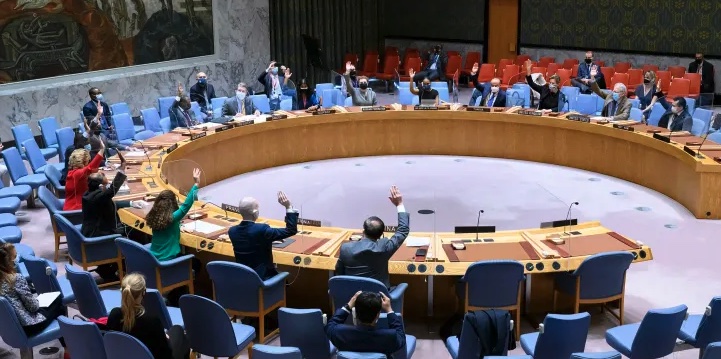
The photo shows a unanimous vote at the U.N. Security Council in January 2022, affirming that nuclear wars must never be fought
Unless your name is Tom Friedman, I guess you’d agree that the world is not flat. But what shape does our world have today—and what shape of a world do we want to build over the years ahead?
I’m pulling strongly for the kind of multipolar order in which all the world’s children have a decent chance of growing up in an environment with a sustainably livable climate and from which the threat of nuclear ecocide has been removed.
Joe Biden seems to have a different preference. Time after time, and in a rising crescendo this past week, he has loudly been painting the world as dominated by a bipolar fight between what he calls the “rules-based order” and Russian aggression—and one that the “West” (as embodied by NATO) must win… And from the other side of the Ukraine frontline, Russia’s president Vladimir Putin has been loudly proclaiming his own, mirror-image version of that view.
There are two big problems with seeing the world as essentially bipolar:
- The zero-sum-game aspect of any bipolar view of the world entrenches competitive actions at a time when the already evident effects of climate change (hello!) and the threat of nuclear annihilation demand cooperation, rather than competition.
- Our world is already deeply and irreversibly multipolar! Hence, seeing it as bipolar, or acting as if it were, is extremely retrograde and ends up being damaging for all the peoples of the world (and almost certainly counter-productive for any leader who follows such a path.)
We should all be glad that this week, the government of China has published a concept paper for a new “Global Security Initiative” (GSI) that presents a realistic, essentially multipolar description of the nature of global power. And just today, Pres. Xi Jinping has issued a powerful call for a ceasefire and peace talks in Ukraine that is clearly derived from the GSI’s principles.
There’s no word yet on whether anyone in China’s corps of global diplomats has been exploring with Moscow or Washington whether and how a Ukraine ceasefire can be attained, or what role Beijing or others might play in that diplomacy. (If such contacts are being conducted, by any party, we most likely wouldn’t hear about them until they were close to success… For my part, I live in hope.)
Meanwhile, two studies recently published in “the West” underline the degree to which power in the world has already become widely diffused. In this one, “The New Geopolitics”, Columbia University economist Jeffrey Sachs focuses on the economic underpinnings of today’s world. And in this one, “United West, divided from the rest”, three analysts from the European Council on Foreign Relations look at the degree to which the public attitudes in China, India, Türkiye, and Russia already diverge starkly from those in NATO countries.
In today’s essay, I will quickly summarize the key findings of the Sachs and ECFR papers, then offer my own preliminary thoughts on the nature and shape of power in today’s world.
Continue reading “What shape of a world do we want to build?”