What this war is about

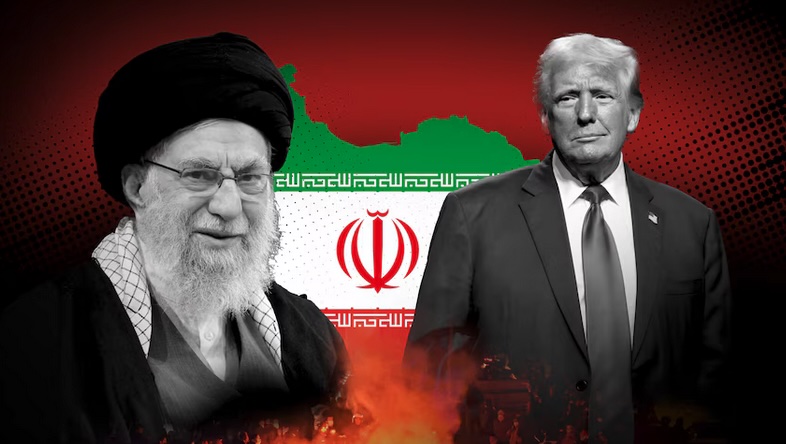
Let me first state what this Israeli-U.S. war against Iran is not about. It is not about “democracy” in Iran. It is not about Iran being anywhere near to– or even working to reach– the threshold of nuclear arms possession.

So what is it about?

For the Zionist settler colonialists of Israel’s always hyper-militarized political elite this war is quintessentially “about” the continued existence of an independent, coherent Iranian state and the ability of this state to project power across much of West Asia. To be precise, for the Israelis, the war is about destroying the Iranians’ capability to maintain any such state.

For much of the (hyper-Zionized) U.S. political elite it is also about this. But in the ruling Republican Party here, the influence of the pro-Israel crowd has been sharply contested in recent months. And even in the (chronically pro-Zionist) Democratic Party leadership circles, the pro-Israel narrative has lost considerable power, especially among the broad ranks of politically engaged, and mainly younger, people. The perennial pro-Israel narrative does retain a strong grip on most of the country’s legacy media; but the reach and influence of that media has waned sharply in recent years, especially since October of 2023.

So a very large mass in the U.S. engaged body politic no longer buys Israel’s narrative about this war. Meantime– and this is worth noting– a very large portion of the engaged body politic has important family investments in the U.S. stock market, through their (our) retirement funds. Plus, nearly everyone in the U.S. is concerned about prices at the gas pump and their knock-on effect. So if they do not buy the Zionist narrative, for most of these people, why should they support this war, especially knowing that its economic costs will certainly continue to balloon, the longer it continues?


I have a different framework for looking at this war. I do not see it as being “just” about West Asia (the region formerly known as the Middle East), or “just” about the next one or two rounds of U.S. elections. I look at it from a perspective that is both historically and geographically much broader.

Continue reading “What this war is about”
No to war on Iran! No to U.S. hegemony!

Most people in the United States and other Western nations seem to consider it “normal”, or anyway unremarkable, that the U.S. should, on its own, have the authority to control and police the nuclear-enrichment projects of another country far away.

It is not.

There are a number of high-level UN bodies, with the Security Council at their apex, that have that authority. In 2015, the United States, the other four veto-wielding permanent members of the Security Council, and Germany jointly negotiated an arrangement with Iran that sought to address concerns that some countries had had about Iran’s nuclear-enrichment program. The agreement they reached, the “JCPOA”, was immediately endorsed by the Security Council.

In 2018, Pres. Donald Trump unilaterally pulled out of the JCPOA and restored many of the unilateral U.S. economic sanctions on Iran that had earlier been lifted under its terms. The JCPOA’s other (non-Iran) signatories expressed mild concern at Trump’s move, but took no other action. (When Joe Biden became president he took some inconsequential steps to rejoin the agreement, then abandoned the project.)

Continue reading “No to war on Iran! No to U.S. hegemony!”

U.S. sanctions are terrorism on an industrial scale

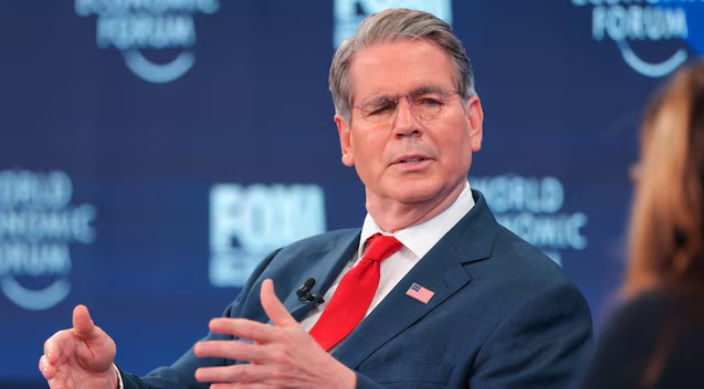
U.S. Treasury Secretary Scott Bessent blurted out an important truth at the Davos conference, January 20. He described the way Washington has wielded the weapon of economic sanctions against Iran as “economic statecraft” crowing that:

It’s worked because in December, their economy collapsed. We saw a major bank go under. The central bank has started to print money. There is a dollar shortage. They are not able to get imports, and this is why the people took to the streets… Things are moving in a very positive way here.

Journalism prof Azadeh Moaveni gave a detailed account in this powerful piece in the Financial Times January 17, of how Bessent and the rest of Trump’s team had tightened the screws on the Iranian economy starting back last March:

Continue reading “U.S. sanctions are terrorism on an industrial scale”

Trump’s Iran backdown

There was Trump, on Tuesday, shouting all over the internet, “Iranian Patriots, KEEP PROTESTING – TAKE OVER YOUR INSTITUTIONS!!! … HELP IS ON ITS WAY. MIGA!!! PRESIDENT DONALD J. TRUMP.” And there was Trump just a day later saying, “We’ve been told that the killing in Iran is stopping — it’s stopped — it’s stopping… And there’s no plan for executions, or an execution, or execution — so I’ve been told that on good authority.”

He was racing backward from the incendiary regime-change rhetoric of the previous day.

This was– for now, anyway– a clear case of “TACO, Iran-style”, to borrow the FT’s great acronym for “Trump Always Chickens Out.” Read on to see where I think this leaves us all now. But first, a bit of essential background.

Back in late June, in the aftermath of the “12-day War” that the U.S.-Israeli axis launched jointly against Iran June 13, I made a number of judgments, and shared some of them here and here. In the first of those essays, I judged that the reason that war ended so (relatively) swiftly and cleanly was that by June 24-25 both Israel and Iran found themselves locked in a “mutually hurting stalemate.” It was most certainly not any kind of “cakewalk” for the U.S.-Israel axis, and it certainly did not result in the unassailable U.S. win that Pres. Trump hurried to present it as.

Continue reading “Trump’s Iran backdown”

Why a set of treaties from 1648 CE is more important than ever

If you’ve never learned about the 1648 Peace of Westphalia, then now is an excellent time to do so. This set of treaties, agreed to by the leaders of more 100 little European statelets and dukedoms in an era in which the modern-style “nation state” was only just emerging, laid the ground rules for the international state system that has existed until today. Its core principle was the sovereign independence and equal standing of all states in the system.

That principle, as extended to and embraced by all the 193 states in today’s international system, lies at the heart of the Charter of the United Nations, as adopted in San Francisco in 1945. In Article 2, the UN Charter states clearly that:

(1) The Organization is based on the principle of the sovereign equality of all its Members…

(4) All Members shall refrain in their international relations from the threat or use of force against the territorial integrity or political independence of any state, or in any other manner inconsistent with the Purposes of the United Nations.

As we know, in the 80 years since 1945 many states have violated these principles of the Charter (and many others.) But the action the U.S. government took on January 3, sending military forces to violently blast their way into the home of the head of another sovereign state and to snatch him and his wife and take them to U.S. territory on a flimsy judicial pretext, has been among the most egregious and the most threatening to today’s whole system of international law.

Continue reading “Why a set of treaties from 1648 CE is more important than ever”

As the UN crumbles, what?

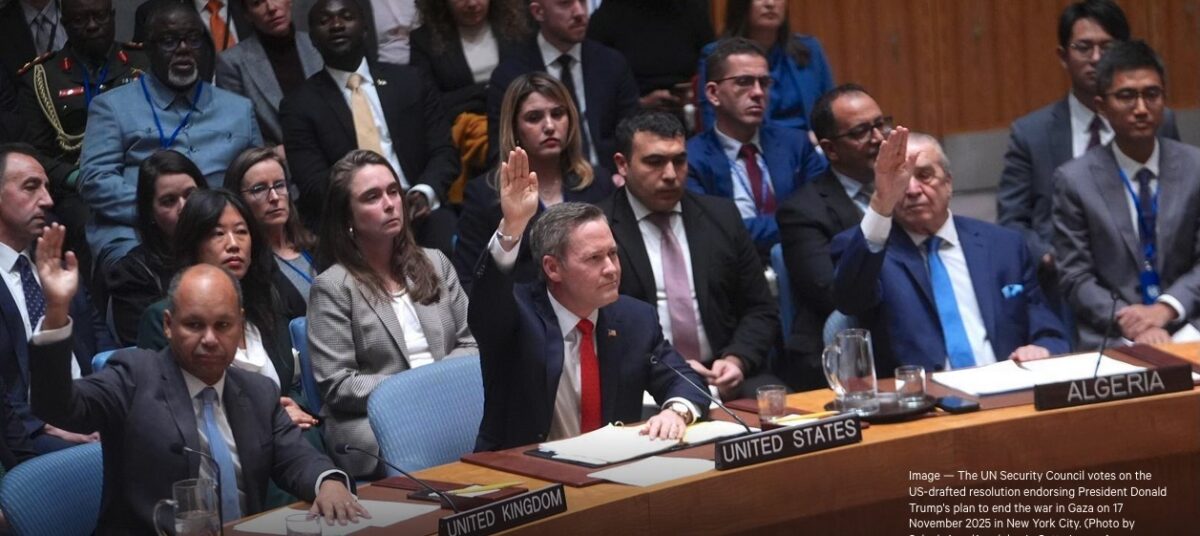
As someone born in the early 1950s, I have never known a world without the United Nations. But by adopting Security Council Resolution 2803 (text) on November 17, the 15 states that sit on the UN’s most authoritative body, the Security Council, have now knowingly given a green light to the genocidal American-Israeli assault on Gaza, in clear violation of all the norms and values on which the UN was founded.

Thirteen of those states (including four Muslim-majority nations) voted for the U.S.-presented resolution. China and Russia, either of which could have blocked it by wielding a veto, chose not to do so. It seems that all those 15 states are prepared to rip up the entire international “system” of which the UN is the linchpin, and to let the world crumble into a stew of “might-makes-right” anarchy.

Craig Mokhiber, the 30-year veteran of the UN’s human-rights system who resigned his post in late October 2023 when he accused the UN of having failed to prevent Israel’s already-underway genocide in Gaza, published a powerful and well-documented piece on Resolution 2803 on Mondoweiss November 19. It clearly laid out the many ways in which Resolution 2803 violated longstanding UN norms, including those enshrined in its 1945 Charter.

In a discussion with Ali Abunimah on the EI Livestream yesterday, Mokhiber developed his critique even further. He noted that Resn. 2803 gives Pres. Trump the sole authority, via his position as head of the grotesquely mis-named “Board of Peace”, to do anything he wants regarding the administration of Gaza. Mokhiber’s comment: “It’s not even colonial, it’s King Leopold-esque.” (That recalled the fact that during the grossly genocidal period of “Belgian” rule over the Congo, 1885-1908, that whole vast territory was being administered as the personal property of Belgium’s King Leopold II.)

Continue reading “As the UN crumbles, what?”

Zionism (& other settler colonialisms) in world-historical perspective

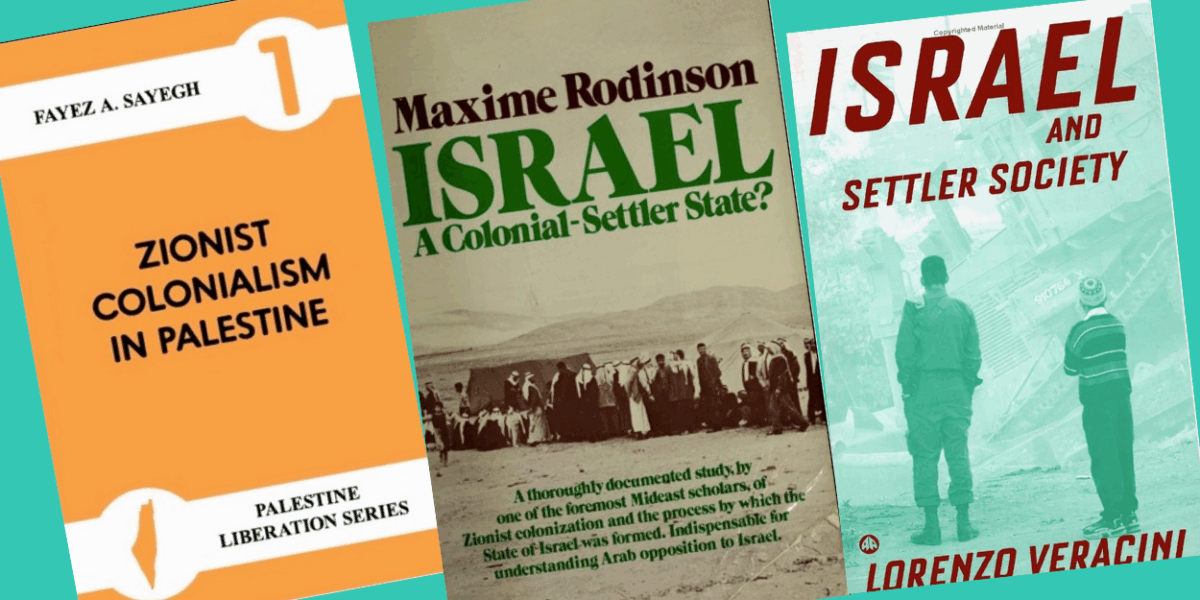
It’s been a long time since I read either Fayez Sayegh’s seminal Zionist Colonialism in Palestine (1965) or Maxime Rodinson’s Israel: A Colonial-Settler State? (1973.) In the intervening decades, a lot has happened…

Sayegh was one of the intellectual fathers of the famous “Zionism is Racism” resolution that UN General Assembly adopted in 1975, and rescinded, under super-heavy American pressure, 16 years later. He died in 1980…

Rodinson was a brilliant French Marxist and an early and vocal supporter of Palestinian rights. (His use of the question-mark in his book’s title I emulated in my 2004 book Amnesty After Atrocity?; in both cases, it was a way of indicating that we had heard and engaged with the arguments of the critics of our main thesis.) Rodinson died in 2004…

Other things that have happened since I read those two books were:

Continue reading “Zionism (& other settler colonialisms) in world-historical perspective”

The status and meaning of Trump’s Gaza ceasefire deal

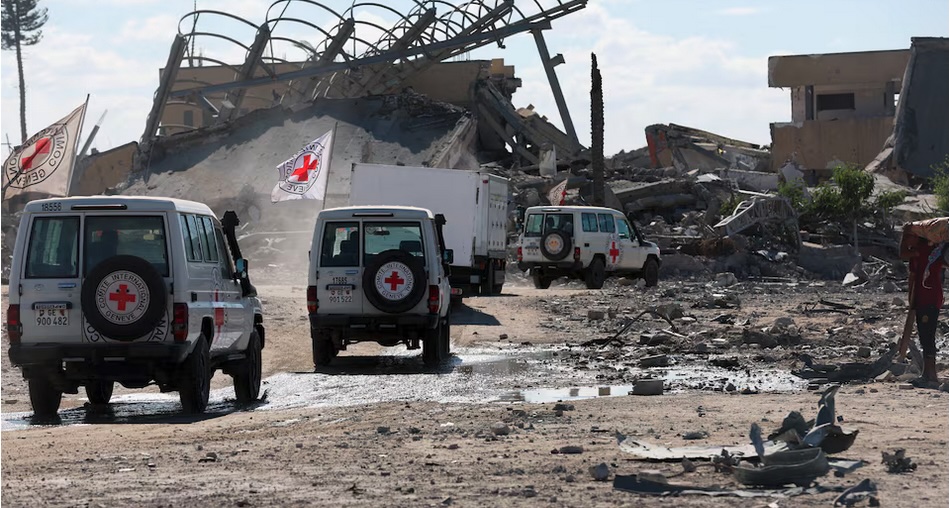
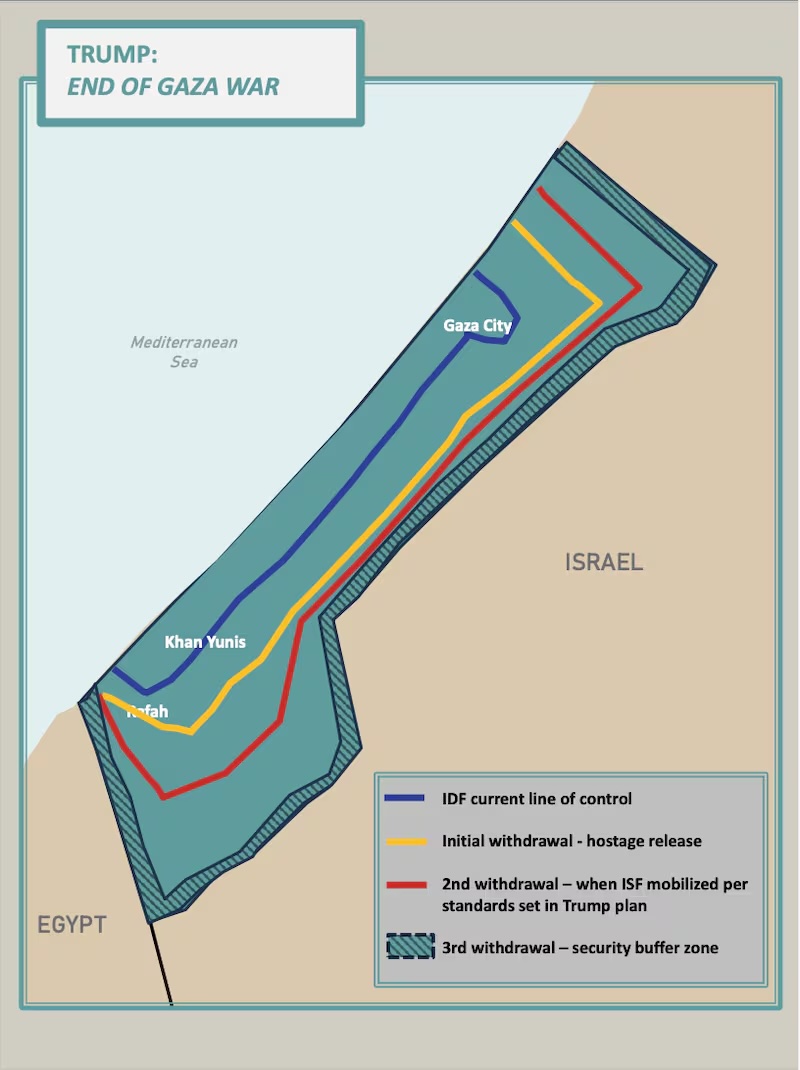
On October 10, the devastating bombings and other attacks that the Israeli military has undertaken against Gaza nearly continuously for the past two years finally came a halt. (Or nearly so, see below.) The Israeli military’s massive tanks and bulldozers began to lumber their way out of some– but far from all– of the parts of Gaza they had devastated over those 24 months. Some aid trucks started to roll in. Hundreds of thousands of the Palestinians who’d been forced, under withering Israeli fire, to evacuate south from Gaza City started to trudge back north to their former– very often completely pulverized– homes.

Phases of withdrawal in Trump’s plan. Source. Click to enlarge.

U.S. Pres. Trump was the one who successfully forced the Israeli government to sign onto that ceasefire agreement. (He could, at any moment since his inauguration back in January, have used Washington’s near-complete sway over Israel’s military decisionmaking to force that same outcome… And so, at any point in the preceding 15 months, could his predecessor in the White House. How many thousands of lives and destinies would have been saved?)

On October 13, as the reciprocal captive-exchange portions of the October 10 agreement were completed, Trump organized two large, splashy public events– one in Israel, one in Egypt– at which with his now horribly familiar braggadocio he took his victory laps for the ceasefire.

Continue reading “The status and meaning of Trump’s Gaza ceasefire deal”

Hamas in negotiations– and on the ground

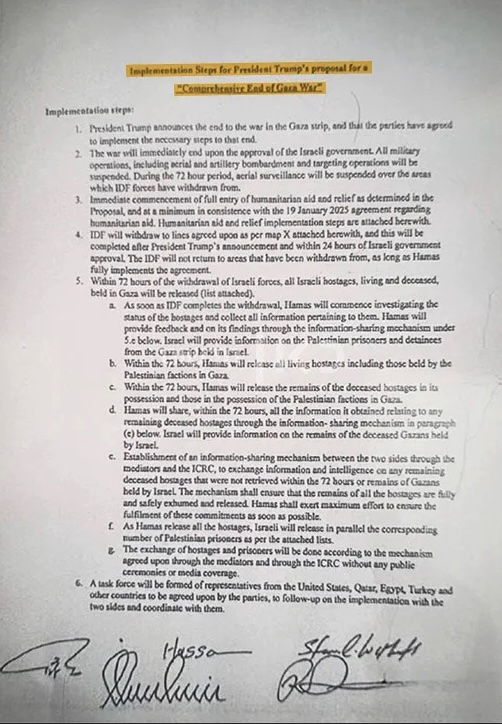
Text of Oct. 9 agreement. Click to enlarge.

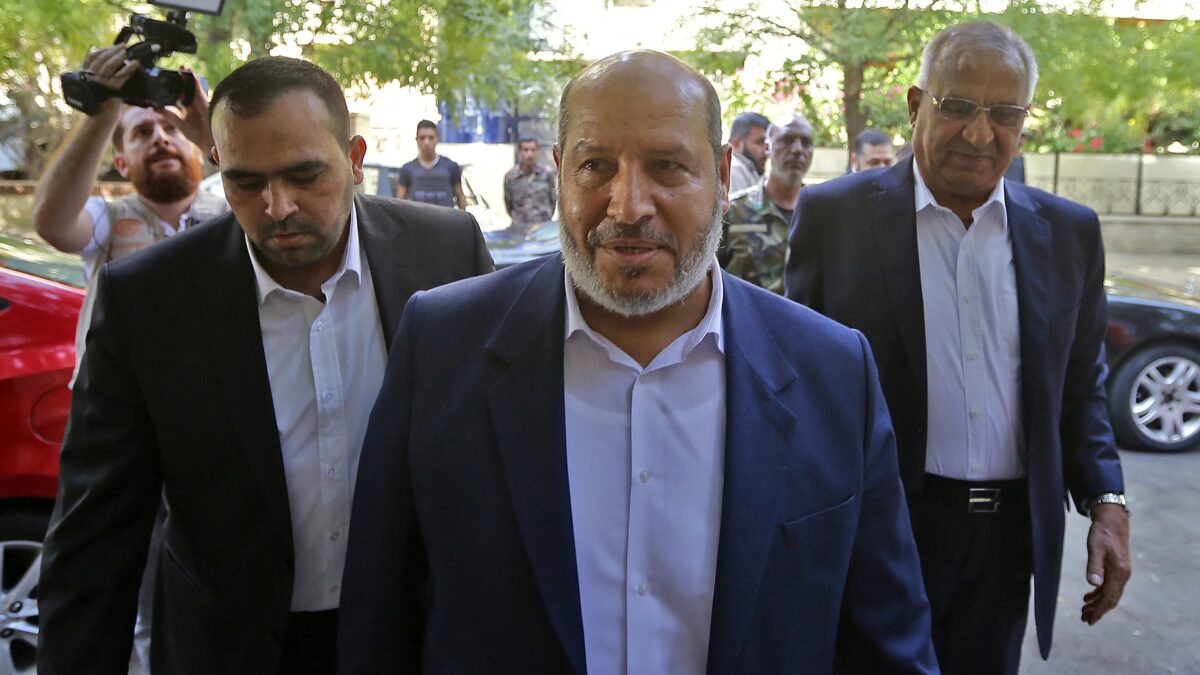
The clock started ticking at Noon Palestine Time today on implementation of the 6-step ceasefire + captive-release agreement negotiated in Sharm el-Sheikh, Egypt, by Pres. Trump and his three Muslim-state mediation partners. Those talks were held on a “proximity” basis with, presumably, the Israeli negotiators in one room, the Palestinian resistance alliance led by veteran Hamas negotiator Khalil al-Hayya in another, and various groups of mediators shuttling between them.

(That’s Khalil Al-Hayya, above.)

The negotiators in Sharm had reached agreement on their 6-step plan on Thursday, but per Step 2 therein, implementation awaited the approval of the Israeli government. That was achieved this morning.

The prescribed ceasefire and many signs of an Israeli military pullback started at Noon today (local.) By that time, thousands of Palestinians whom the Israelis had previously expelled south from Northern Gaza under fire were already streaming back toward their homes in the north.

Continue reading “Hamas in negotiations– and on the ground”

On ‘Condemning Hamas’

I was at an in-person event here in Washington yesterday, and I raised the matter of Hamas, noting that the title of Rami Khouri’s and my recent book Understanding Hamas And Why That Matters is still very relevant. One of the speakers was the Egyptian-American Washington Post columnist Shadi Hamid. He responded by making a few fairly smart observations– but then he loudly repeated the injunction that has been his watchword throughout the past two years: “We must condemn Hamas!”

I guess that is the price Hamid feels he must pay to have access to the pages of Jeff Bezos’s failing, but still influential, rag here in the U.S. capital. Maybe he even believes it. But why? What does it actually mean to “condemn” an entire movement– and one, moreover, with which our national government has been negotiating, with varying degrees of intensity, for more than 18 months now?

A movement, therefore, whose inner workings and worldview it would presumably be very useful for both government officials and informed citizens to understand as well as possible…

Continue reading “On ‘Condemning Hamas’”