What this war is about

Let me first state what this Israeli-U.S. war against Iran is not about. It is not about “democracy” in Iran. It is not about Iran being anywhere near to– or even working to reach– the threshold of nuclear arms possession.

So what is it about?

For the Zionist settler colonialists of Israel’s always hyper-militarized political elite this war is quintessentially “about” the continued existence of an independent, coherent Iranian state and the ability of this state to project power across much of West Asia. To be precise, for the Israelis, the war is about destroying the Iranians’ capability to maintain any such state.

For much of the (hyper-Zionized) U.S. political elite it is also about this. But in the ruling Republican Party here, the influence of the pro-Israel crowd has been sharply contested in recent months. And even in the (chronically pro-Zionist) Democratic Party leadership circles, the pro-Israel narrative has lost considerable power, especially among the broad ranks of politically engaged, and mainly younger, people. The perennial pro-Israel narrative does retain a strong grip on most of the country’s legacy media; but the reach and influence of that media has waned sharply in recent years, especially since October of 2023.

So a very large mass in the U.S. engaged body politic no longer buys Israel’s narrative about this war. Meantime– and this is worth noting– a very large portion of the engaged body politic has important family investments in the U.S. stock market, through their (our) retirement funds. Plus, nearly everyone in the U.S. is concerned about prices at the gas pump and their knock-on effect. So if they do not buy the Zionist narrative, for most of these people, why should they support this war, especially knowing that its economic costs will certainly continue to balloon, the longer it continues?


I have a different framework for looking at this war. I do not see it as being “just” about West Asia (the region formerly known as the Middle East), or “just” about the next one or two rounds of U.S. elections. I look at it from a perspective that is both historically and geographically much broader.

Continue reading “What this war is about”
The long marriage of financial speculation, settler colonialism, and savagery

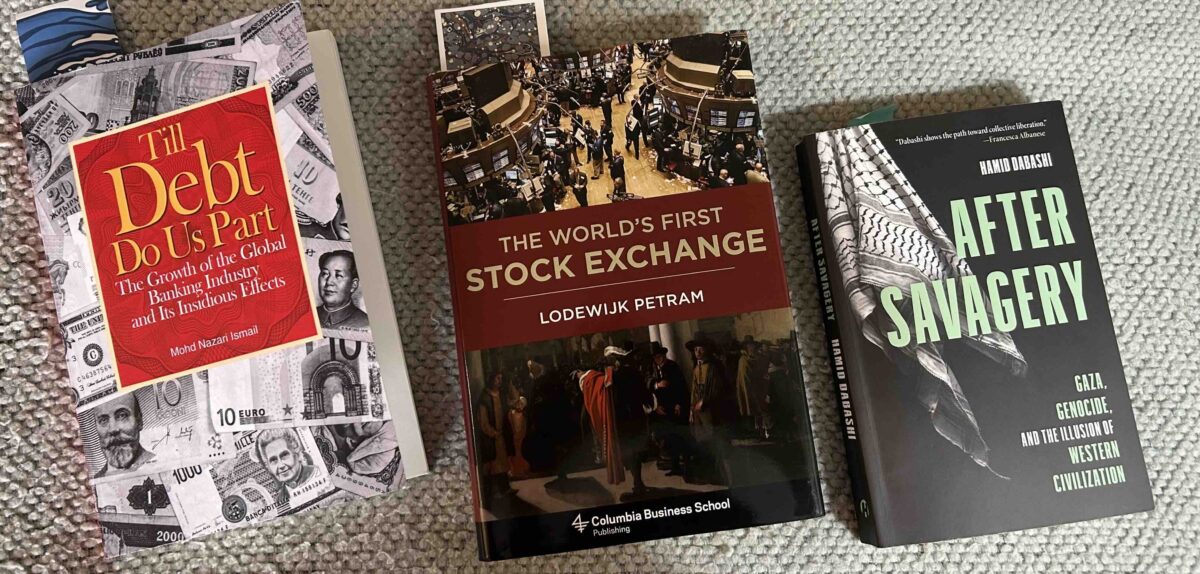
I’ve been reading Hamid Dabashi’s thought-provoking new book After Savagery: Gaza, Genocide, and the Illusion of Western Civilization. It is a very useful documentation of, and reflection upon, the extreme savagery of Israel’s (still-ongoing) genocide in Gaza and also, importantly, what the very active support that many “Western” nations have given to this genocide tells us about the culture or “civilization” of the West. Throughout the book, Dabashi provides long excerpts from both the poignant “resignation letter” on Gaza that the former UN human rights official Craig Mokhiber penned to his UN bosses in late October 2023, and Sven Lindqvist’s landmark 1992 book ‘Exterminate All the Brutes’: One Man’s Odyssey into the Heart of Darkness…

I heartily recommend that everyone read Dabashi’s book, but I have a couple of quibbles. One is just to note that we are by no means yet “After” the savagery of Israel’s genocide in Gaza. If I were publishing the book I would have urged another title, such as In a Time of Savagery… I have also seen news of a book by Pankaj Mishra titled The World After Gaza, which has received mixed notices. But the world is decidedly not yet “after” Gaza, or Israel’s pursuit of savagery therein!

I think what we can say at this point, even as Israel’s savagery in Gaza continues, is that the first two years of the genocide and the behavior of various world powers during those years have already provided humankind with a shockingly rich trove of evidence about the savagery of this Israeli government, of the Zionist political project of which it is a product– and of those “Western” and other powers that have actively aided the genocide.

And who know what more the coming months or years will reveal about these matters?

Continue reading “The long marriage of financial speculation, settler colonialism, and savagery”

For the commanders of Western hegemony, cruelty is a vital tool

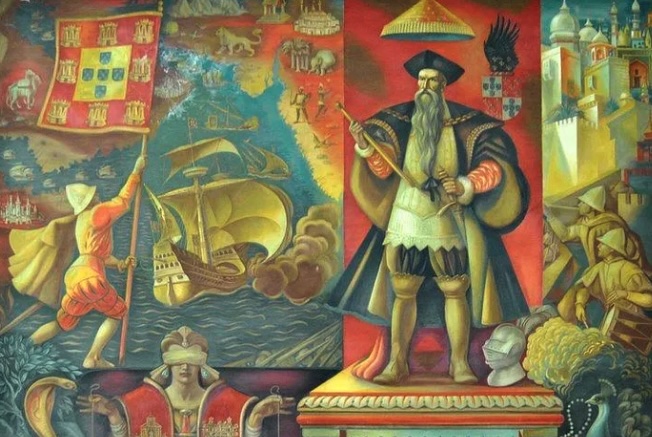
The painting above is of Portuguese conquistador Afonso de Albuquerque

For Pres. Trump, cruelty is a vital tool as he bulldozes through all constitutional requirements to undertake (and publicize) exemplary deportations of undocumented immigrants and of any legally documented visitors like Columbia University’s Mahmoud Khalil whom he arbitrarily chooses to punish.

For Israel’s PM Netanyahu and his ministers, cruelty is similarly a vital tool as they deploy waves of bombers and incendiary drones against two million Palestinians huddling under tarps on Gaza’s trash-piled shores while totally blocking the entry into Gaza of all the basic necessities of life.

Indian Ocean trading routes before da Gama. Click on image to enlarge.

It’s worth noting that cruelty has been a vital, and deliberately deployed, tool for the architects and commanders of “White” empires ever since the 15th century CE. In 1415, Portuguese navigators started carving their way down the coast of West Africa to establish heavily fortified “trading” (plunder) posts in their quest for gold. Those navigators were also intent on finding a sea-route to the richest trading zone they’d ever heard of, the one that traversed the Indian Ocean and wove the riches of East Africa, India, and distant Cathay (China) into the most advanced manufacturing and consumption area then known to humankind…


Continue reading “For the commanders of Western hegemony, cruelty is a vital tool”

The Red Sea in history and today

I was planning to write a quick essay here about how the Houthis’ robust pro-Gaza-ceasefire actions in the Red Sea have further strengthened the already clear (can we say “ironclad”?) tie-up between Israel’s ongoing genocide in Gaza and the massive shifts now underway in the balance of global power.

I will get to that a little more, below. But meantime the confrontations in the Red Sea and the adjacent Gulf of Aden seem to be escalating—along with the tensions between the U.S. ground/expeditionary forces at the crucial confluence of the Syria-Iraq-Jordan borders, where on Sunday, local anti-U.S. militias killed three U.S. service-members and injured dozens more in a drone attack.

In the global diplomacy over Gaza, much attention has been paid to the (not notably successful) missions that Sec. of State Blinken and CIA Director Bill Burns have been undertaking to try to win that ever-elusive Gaza-Israel ceasefire. Much less attention has been paid to the trip that Biden’s National security Advisor Jake Sullivan made to Bangkok last Friday, where he met with top PRC diplomat Wang Yi to try to persuade Wang to pressure Iran to rein in the Houthis’ actions in the Red Sea.

Continue reading “The Red Sea in history and today”

The Arabian Peninsula at the Hinge of History

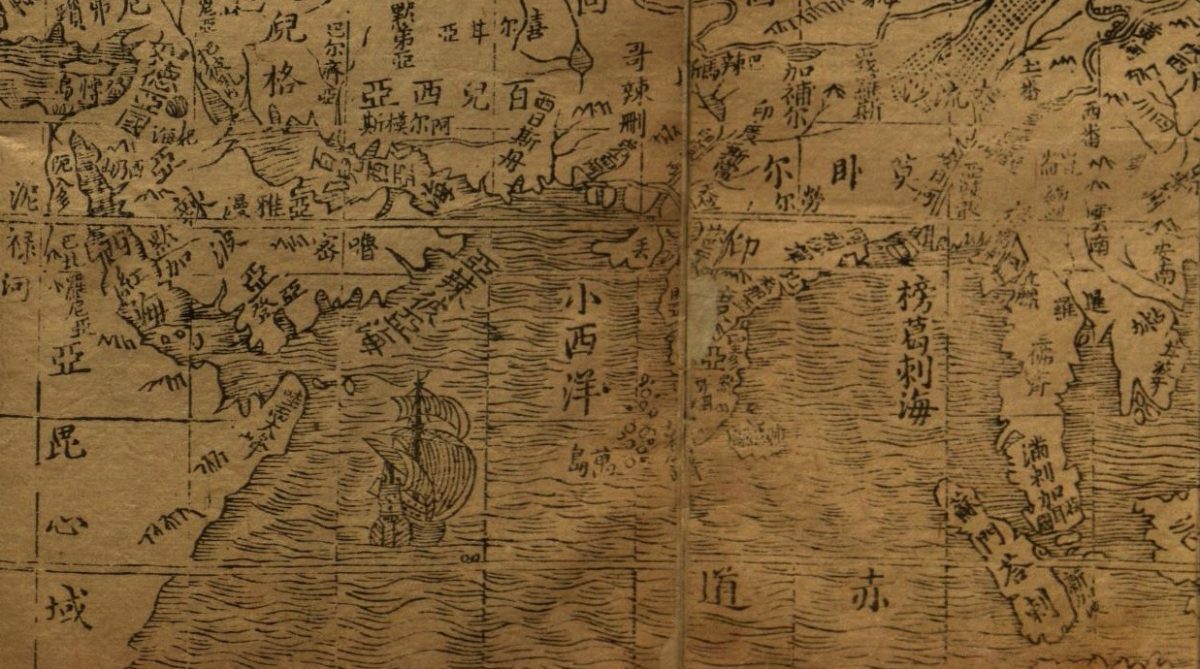
(An early 17th century Chinese map of part of the Indian Ocean, using data gathered by Zheng He’s voyages of 200 years earlier. The Arabian Peninsula is at the left. Source.)

Over the past couple of months, in my essays here at Globalities I’ve been tracking the current crumbling of the decades-old system of Washington’s global hegemony and its gradual replacement by a China- and BRICS -led system of multipolarity—and also some of the effects of that shift, in West Asia and elsewhere. Most recently, we’ve seen China’s President Xi Jinping pushing forward his previously announced readiness to help resolve the conflict in Ukraine. If successful, this initiative could bring about a further large diminution of U.S. power in the world.

We should all continue watching the progress of the China-led peace initiative for Ukraine very closely. In today’s essay, however, I want to explore some of the impact that this “West to the Rest” shift has already been having in West Asia (the region formerly known as “the Middle East”), and especially in and around the Arabian Peninsula.

Until recently, all the states of the Peninsula, with the exception of some substantial quasi-state actors in mountain-haven Yemen, have been unambiguously pro-American. The other states on the Peninsula are all wealthy petro-states. They have long maintained strong relationships with Washington under an arrangement whereby the United States promised to give them military protection provided they would continue to underwrite the U.S. military-industrial complex by buying large (and often quite unusable) inventories of U.S. weapons, and to support the role of the U.S. dollar in the global economy.

But in recent years, and even more rapidly since last year’s start of the big conflict in Ukraine,that “devil’s bargain” has started to fall apart. As Jon Alterman wrote recently about the region in Defense One:

Continue reading “The Arabian Peninsula at the Hinge of History”