

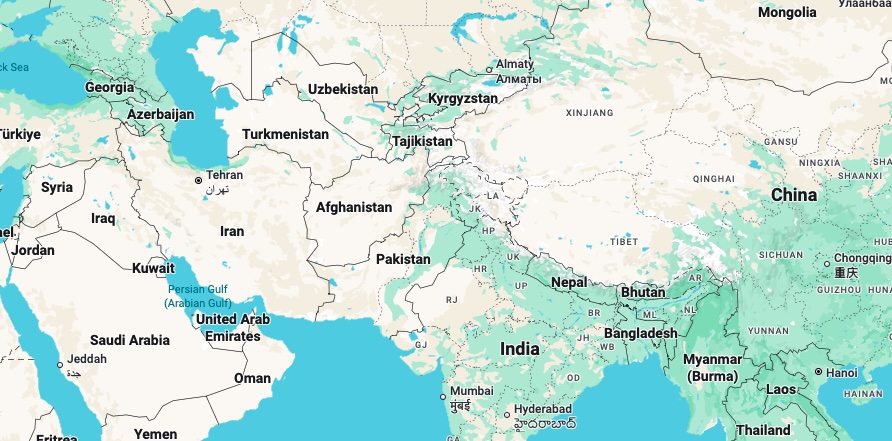
This has been a big week in geopolitics. On Tuesday (March 31), the Pakistani and Chinese foreign ministers jointly announced, in Beijing, a “5-point initiative” to end the Israeli-U.S. War on Iran. (PDF of the text is here.) In preparing that text, the two ministers had consulted closely with their counterparts in three Muslim-majority countries: Egypt, Turkey, and Saudi Arabia. Those three governments speedily expressed their support for it. (Just four days earlier, Pres. Trump had publicly and crudely insulted Saudi Arabia’s effective ruler, Prince Muhammad Bin Salman, MBS, at a big investment conference in Miami that had been financed by Saudi Arabia.)
On Wednesday (April 1), Pres. Trump gave the grand pre-announced “address to the nation”— the first since the Israelis and he launched this war on February 28— at which it was expected he would announce either a significant off-ramp or a significant escalation. He did neither. Instead, he delivered a jumbled word salad concocted from fragments of several of his social-media postings from the preceding days. The word salad did, however, include some very crude (and quite illegal) threats to attack Iranian infrastructure and to “bomb Iran back into the Stone Ages.” Those threats were paralleled by separate, equally crude threats against Iran uttered by Secretary of “Defense”/War Pete Hegseth, who yesterday also summarily fired the Army Chief of Staff and some other high-ranking members of the U.S. officer corps.
These past few days have also seen other significant, wide-scale diplomatic activity including an attempt by Bahrain— which this months holds the chair of the UN Security Council— to ram through a resolution that, like the one passed on March 11, would make no mention of the role of the U.S. and Israel in having initiated and very violently sustained the current war but would castigate only Iran for the retaliatory actions it took. In addition, the initial draft presented by Bahrain this week would have invoked a “Chapter VII” provision that would allow the military of any country or countries in the world to use force to open the Strait of Hormuz.
Bahrain and the other states pushing for the new resolution had been hoping to put it to a vote today. But in another notable development, late last night they announced they would not be doing so— and equally notably, they did not announce a new date for this vote…
The key role of Saudi Arabia
I have been thinking/arguing for some time now that the crucial indicator for when and how this vile imperial war the U.S. has been waging against Iran will end will not be, as most Western pundits have assumed, the decisions that Donald J. Trump may make, but rather, the decisions that made by MBS and the rest of the House of Saud. (One wag summed this up this phase of the war as being “A struggle for the soul of Saudi Arabia— if Saudi Arabia could be said to have a soul.”) But truly, doing the patient diplomatic work required to bring Riyadh and the other Gulf Arab states over into the “sustainable peace with dignity” (SPWD) camp and away from the “Epstein alliance” of warmakers has been the main focus of the governments of both China and Pakistan. It now looks as though they’ve been notching up some real achievements and are on a course to win some more.
Bringing into the SPWD camp not only Saudi Arabia but also Egypt and Turkey has been a real victory. Turkey, remember, is actually a member of NATO. And the government of Egypt has been on the U.S. payroll ever since the Camp David Accords of 1978. The Chinese and Pakistani diplomacy, as I understand it, has not required that any of those three government cut all their ties with Washington. Instead, it has persuaded them that continuing this war is very bad for their own interests and also, absolutely crucially, that negotiations and diplomacy are the best way to bring it to a stable and sustainable end.
On Wednesday, in the excellent public conversation I conducted with Amb. Chas Freeman, we plumbed many of these issues in some depth. You can find a summary of it, and links to the video, audio, and whole transcript, at this post on the JWE blog. I always learn so much from him! He provided some really informative insights into the many deep dimensions of the Pakistani-Saudi relationship. We also jointly explored some of the really important concepts that are clearly stated in the Chinese-Pakistani initiative— including its stress that ”Sovereignty, territorial integrity, national independence and security of Iran and the Gulf states should be safeguarded” and its powerful invocation of International Humanitarian Law and the “Primacy of the United Nations Charter.” If you have not yet read the 5-point initiative, I urge you to do so.
It is my view that these key principles of international law would, if fully subscribed to by Saudi Arabia and other Gulf Arab countries make a complete dead letter of the “Abraham Accords” arrangement that some of them— crucially, Bahrain and the UAE— have entered into with Israel.
Reeling in the Arab Gulf states
From this point of view, you could describe the diplomacy that Beijing and Islamabad have been patiently pursuing for some time now, and most particularly since the Israeli-U.S. axis unleashed this ghastly current war, as constituting a patient project to reel in as many of the Arab Gulf (GCC) states as possible into the SPWD camp and away from the Abraham Accords camp. Saudi Arabia has been the big catch, since of the three Muslim-majority states that are fully on board with the 5-point initiative they’re the only one that the Zionists ion Tel Aviv and Washington have ever really hoped could be brought into the Abraham Accords.
The UAE and Bahrain could be harder to reel in. Both of them have long been deeply enmeshed not just in all the Israel-centered fol-de-rol of the Abraham Accords but also in U.S./Western imperial planning for West Asia more broadly. But stacked up against Saudi Arabia, by most metrics they really are midgets. Populations, for example:
- Saudi Arabia: total popn 35.3 mn, of whom 20.6 mn (58.4%) are citizens.
- UAE: total popn 11.35 mn, of whom 1.25 mn (11%) are citizens.
- Bahrain: 1.59 mn, of whom 0.74 mn (46.6%) are citizens.
Maybe if you looked at GDP or size of sovereign wealth funds or whatever the disparity would be less. But still, very sizeable.And a quick note here about the citizens vs. non-citizens ratio. Can we really expect the 89% of residents of the UAE who are not citizens to want to stay around for long if the place is (a) demonstrably unsafe and (b) much less wealthy than it has been until now? In all the Gulf countries, a very high proportion of the non-resident population is made up of service workers, and a much, much smaller proportion of the high-end movers, shakers, investors, tech developers, and “influencers” who get written about in the New York Times.
Also, a quick note about Bahrain. Bahrain has long been a favorite hangout for British spooks, colonial administrators, and even actual torturers like this one. Their expertise was needed long after that little island won its “independence” from Britain in 1971— precisely because the Bahraini citizenry is extremely heavily weighted toward Shiite Muslims, while the “monarchy” to which London handed over governance of the island is deeply Sunni Muslim. Hence the need for torturers.
Hence, too, the great significance of the facts that (a) it has, by chance, been the government of Bahrain that is the current “representative” of the League of Arab Nations on the UN Security Council— and that this month, in particular, it has been Bahrain’s rep that has been chairing the whole Security Council; that (b) Bahrain has, since April 1, been trying to use that privileged position on the SC to ram through yet another SC resolution that would go even further than the one of March 11 to line the whole Security Council up behind the U.S.-Israeli agenda in the war against Iran; and © that through some quick and effective diplomacy conducted mainly yesterday, the opponents of the Epstein Alliance were able to block that plan.
Diplomacy at the UN
It’s important to note, too, that the diplomacy that Beijing and Pakistan have spearheaded has been winning supporters from various other states around the world. In particular, I’d note that France went on the record at the SC yesterday, alongside China and Russia, as they argued against pushing Bahrain’s resolution on Hormuz into a speedy vote. So of the five veto-wielding Permanent Members of the SC, that left only Britain and the U.S. eager to let Bahrain’s resolution proceed.
Now we can argue (as I certainly have) that the abstentions that China and Russia both registered on the two key SC votes on Gaza (on November 17 ) and Iran (on March 11) were pretty shameful since either or both of those countries could have killed those terrible resolutions by using their veto. But both times, they chose not to do that. After the November vote, which was the one by which the SC adopted the entirety of the terrible “Trump Plan” for Gaza, I asked Chas Freeman what he thought had motivated China not to veto it. One of the reasons he gave in his reply was this: “China traditionally defers to the Arab consensus and many of the Arabs, to their great shame, endorsed a version of the Trump plan.”
So now, on this matter of the search for a sustainable off-ramp from the Iran War, the Chinese— with considerable help from their long-time friends in Pakistan— have shown themselves able to get both of the Arab world’s two weightiest governments on board the 5-point initiative, even before it was announced. So I guess that is certainly something. Let’s see how this diplomacy proceeds from here.
Some final thoughts
Four final notes here:
- It has not only been France that, among other governments around the world, have been working to bolster the peace-initiative approach to ending this conflict. I’ve seen reports that Indonesia and the Philippines have both been having consultations about it with China. I’m pretty certain that Spain and many other governments have, too.
- Of related interest: today we had the first reports, on the maritime site GCaptain, that “A French container ship and a Japanese-owned tanker have crossed the Strait of Hormuz” in recent hours. So I guess the Iranian toll-booth has been open for business!
- The steps that China, Russia, France, and others have been taking to prevent the Security Council from voting on yet another blatantly pro-Washington, pro-Israeli resolution may turn out to be steps that save the integrity, legitimacy, and effectiveness of the United Nations for some time to come? Let us hope so.
- I had been hoping to also write a piece that explores both the intriguing dynamics of the Pakistan-China relationship— anyone remember the victory their military tech won over Western tech in the short air war of last May?— as well as the different but complementary skills/levers they each bring to this campaign to reel in, in particular, Saudi Arabia and the other Gulf Arab states. But I don’t have time to do that right now…
