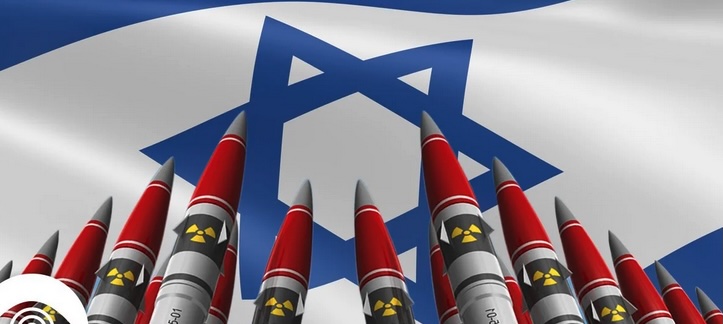
Cracking the U.S. taboo around Israel’s nuclear bombs

One thing the current Israeli-U.S. war is not about is the (completely unsubstantiated) accusation that “Iran is close to having a nuclear weapon.” One thing it actually is about is the well-substantiated fact that in West Asia it’s Israel that has a robust nuclear arsenal— and that the contortions that all of the U.S. policy elite has gone through for decades now to obfuscate this fact have done a lot to push Washington into its present, world-impacting war against Iran.

Back in the 1950s it was the French government, as well as several well-placed individuals inside the U.S. nuclear-weapons complex, who helped Israel attain the technology and materials it needed to develop its own production of nuclear weapons, which it achieved shortly before its PM Levi Eshkol launched the “Six Day War” against three surrounding Arab states in 1967. (A footnote: that war was also associated with a decision— in that case, by Egypt— to close a key waterway.)

But from then until today, Israel’s leaders have always shrouded its possession of nuclear weapons in a deliberate policy that they call amimut (opacity.) I recall, in the late 1980s, attending several sessions of well-meaning “Track Two” discussions on “nuclear weapons in the Middle East” in which Yehoshafat Harkabi and other key Israeli decisionmakers/experts, along with experts and analysts from Egypt, Europe, and the U.S. all took part.

Harkabi was a true expert of projecting obfuscation!

This policy of deliberate obfuscation was also extremely well developed and maintained among all key branches of the U.S. policy elite. Especially the corporate media, but also all branches of the government, at all levels. A person could very easily get tarred as an “Israel-hater” or an “anti-semite” if she/he dared mention publicly the fact, or even the suspicion, that Israel commanded a weighty nuclear arsenal at the same time that its leaders and supporters around the world were frantically pointing fingers at Iraq, Syria, Iran, or Libya for their supposed dedication to attaining a “the bomb.” (Of those, only Libya ever came close. But in 2003, Pres. Qadhafi unilaterally and verifiedly ended the program. As for Iran, for many decades now the country’s successive Supreme Leaders have repeatedly stated that it is against their religion and their policy to attain nuclear weapons.)

Continue reading “Cracking the U.S. taboo around Israel’s nuclear bombs”

Musk’s digital coup in Washington: Effects and prospects

(Above: A scene from the post-Inauguration lunch in the U.S. Capitol. See Meta’s Mark Zuckerberg, Justice Bret Kavanaugh, Apple’s Tim Cook, and others…)

The digital coup that Elon Musk launched to capture the U.S. government started on January 20 (though it had been prepared for many weeks before then.) On January 20, shortly after Pres. Trump took the oath of office and briefly dropped by a lunch at which tech billionaires mingled closely with Supreme Court justices and senior legislators, he signed an Executive Order that stated,

This Executive Order establishes the Department of Government Efficiency to implement the President’s DOGE Agenda, by modernizing Federal technology and software to maximize governmental efficiency and productivity.

We could think of this as “Communiqué Number 1” of the Musk-Trump coup that we’ve seen playing out ever since.

On January 20, Musk and his digi-goons were ready. By the next day, civil servants arriving in the White House-adjacent Eisenhower Executive Office Building found the door to the space there that had long housed the White House’s Office of Digital Services (ODS) sported a note describing it as now housing “DOGE.” DOGE, the non-governmental body that Musk had been running for some time out of the DC office of his Boring company, had already burrowed itself deep into the core of the U.S. federal apparatus.

Continue reading “Musk’s digital coup in Washington: Effects and prospects”

Jimmy Carter, Ted Kennedy, and AIPAC

The death of former U.S. President Jimmy Carter feels like the end of an era– and all the more so, since it will be followed very speedily by the launch of the Trump/Musk presidency.

There has been much discussion about the echoes between Carter’s failure to win re-election after his first term back in 1980 and the crash-and-burn that doomed Pres. Joe Biden’s more recent, far too-long-pursued attempt to win re-election. The reasons for the two failures were very different. Age, which was the major factor (of many) for Biden certainly wasn’t a factor for Carter. The explanations most U.S. commentators have given for Carter’s resounding failure back in the elections of November 1980 have nearly all centered on his failure to resolve the lengthy and very debilitating crisis over Iranian students’ holding of U.S. hostages and the (linked) issue of the massive disruptions that the collapse of the Shah’s regime in Iran inflicted on the U.S. economy.

But by contrast, very little attention has been paid to the significant effect that Sen. Ted Kennedy’s decision to run against Carter in the Democratic primary much earlier in 1980 had in weakening Carter’s ability to organize a successful re-election campaign. And crucially, the role that dedicated pro-Israel organizing played in encouraging Kennedy to mount that primary challenge to Carter.

Tom Dine

Back in 2009, I secured and was able to report on a short series of interviews with the Kennedy staff member who had been the linchpin of that pro-Israel organizing effort. That was Tom Dine, a man who in 1979 joined Kennedy’s staff in the senate after some years working for the Senate Budget Committee and as a defense-affairs staffer for Sen. Edmund Muskie. “With Ted Kennedy, I was ostensibly doing defense policy, but really I was orchestrating his Jewish-vote efforts,” he told me during those interviews.

Continue reading “Jimmy Carter, Ted Kennedy, and AIPAC”

After the Trump win: The fierce urgency of Palestine in U.S. political life

These past days of hearing Trumpworld roll out the President-elect’s expected nominations for positions in the foreign policy/defense space have been harrowing indeed. As human-rights expert Craig Mokhiber remarked about the choice of far-right bully Elise Stefanik to be ambassador to the UN:

Other countries send diplomats to serve as UN Ambassadors. The US always sends AIPAC-approved Israel shills. And, this time, one who is also an abrasive, bigoted, far-right clown…

The expected nominations of uber-Zionist Mike Huckabee as ambassador to Israel, latter-day “crusade” supporter Pete Hegseth as Secretary of Defense, and so on have been equally disturbing. (One possible bright spot was the report of “First Buddy” Elon Musk having met with Iran’s ambassador to the UN, back on Monday.)

Trump is an unstable, idiosyncratic decision-maker. Although most of his prospective nominations are extremely concerning, we still have zero idea of how he will actually wield his power once he returns to the White House January 20. During his first term in office he fairly frequently over-ruled his own cabinet members, or axed them at short notice. It’s also good to recall the number of times he has railed against foreign wars and the costs of overseas bases, etc.

Continue reading “After the Trump win: The fierce urgency of Palestine in U.S. political life”