
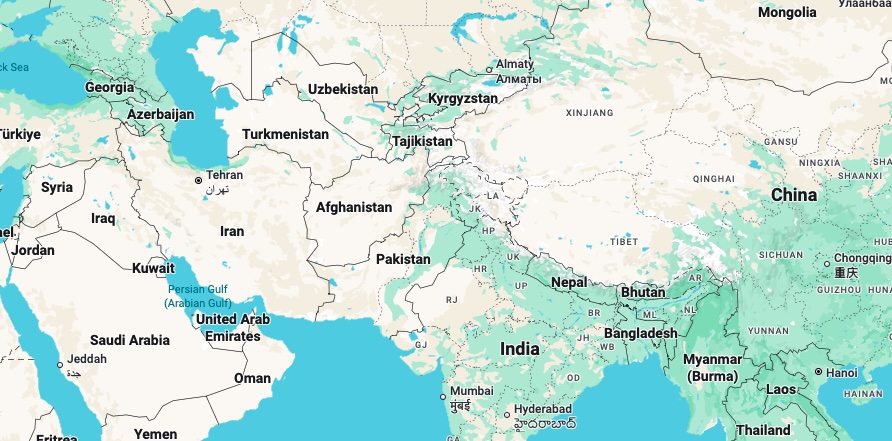
This has been a big week in geopolitics. On Tuesday (March 31), the Pakistani and Chinese foreign ministers jointly announced, in Beijing, a “5-point initiative” to end the Israeli-U.S. War on Iran. (PDF of the text is here.) In preparing that text, the two ministers had consulted closely with their counterparts in three Muslim-majority countries: Egypt, Turkey, and Saudi Arabia. Those three governments speedily expressed their support for it. (Just four days earlier, Pres. Trump had publicly and crudely insulted Saudi Arabia’s effective ruler, Prince Muhammad Bin Salman, MBS, at a big investment conference in Miami that had been financed by Saudi Arabia.)
Continue reading “The China-Pakistan alliance reeling in GCC states (and others) to end the war on Iran”Category: China
The U.S.-Israeli defeat, and its implications
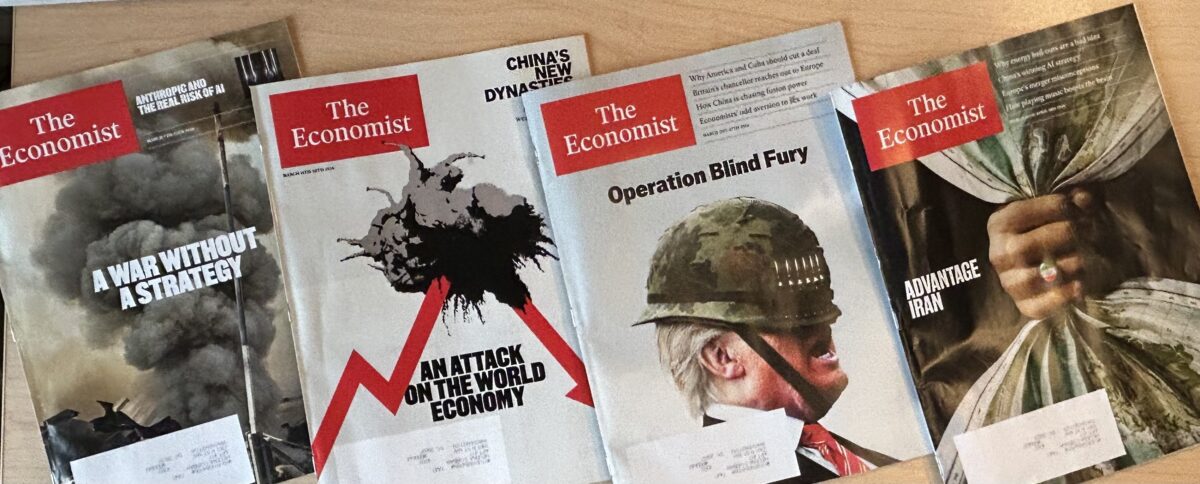
The reality of the defeat of the Israeli-U.S. Axis in the outrageous war of aggression they launched against Iran (and Lebanon) on February 28 is starting to sink in for significant portions of the political elite in “Western” countries.
Above, see the cover art produced by the influential U.K. news magazine The Economist on March 7, 14, 21, and 28 (left to right.) Even prior to the launching of the war, in the issue it distributed February 27 (dated February 28), the mag warned in an editorial that “Starting a war with Iran without a clear objective would be recklessly dangerous.”
In the issue that dropped today, the cover art was unambiguous: “Advantage Iran.” And the wording of its editorial was stern:
Mr Trump must agree to a full ceasefire, and compel Israel to abide by it… Any eventual deal will be worse than what could have been struck before the war began, because Mr Trump has unwittingly strengthened the hand of hardliners and made clear the leverage they have over the strait [of Hormuz.] The result is that for now, at least, the advantage lies with Iran.
I am far from being someone who agrees with all the policy prescriptions peddled by free-marketeer publications like The Economist, the Financial Times, or the Wall Street Journal. But I’ll say this for the first two of these outlets: because they consider that a good part of their mission is to provide information to big shots in the financial markets that is accurate, timely, and non-ideological, a lot of their reporting and their commentary is both on the mark and pretty thought-provoking.
Continue reading “The U.S.-Israeli defeat, and its implications”The War on Iran: Notes on Day 14
Some careful analysts have been declaring a victory for Iran for several days already. Pres. Trump and Poppinjay Pete (Hegseth) have been declaring victory for the U.S. My judgment is closer to that of the “victory for Iran” people– although (1) the war is by no means over yet, and (2) the cost imposed on the peoples of Iran, Lebanon, and Palestine is, and will continue to be, horrendous. Here anyway, are my four current key takeaways, with more explanation below:
- The Islamic Republic of Iran has been holding up well. Its central decisionmaking structure remains in place and it’s been pursuing a smart, long-prepared plan for dealing with this assault.
- The stakes in this contest are global. The IRI deliberately globalized it from the first hours. China has an irreplaceable role in any termination or substantial de-escalation of the conflict. This affects the entire balance of geopolitics.
- The planning, execution, and nature of the Israeli-U.S. assault on Iran have been closely tied to (and grown out of) the Abraham Accords. The failure of the assault should now lead to the end of those accords.
- The choices that GCC leaders make over the coming days will be crucial.
Let’s take these one at a time:
Continue reading “The War on Iran: Notes on Day 14”War on Iran: Global consequences and off-ramps we should support
 Author Posted on Categories Antiwar, China, Diplomacy, Iran, Israel, U.S. military, United Nations1 Comment on War on Iran: Global consequences and off-ramps we should support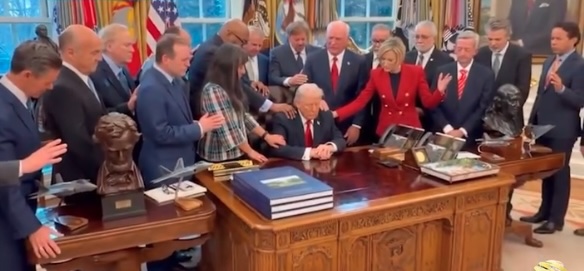
(The photo shows Trump being prayed over in the White House yesterday by a group of evangelical pastors.)
Today is Day 7 of this mass-murdering, mass-destruction project that Pres. Donald Trump named “Operation Epic Fury” (OEF). Already, the dimensions of many of its (quite foreseeable, and by many people clearly foreseen) consequences are becoming evident.
Most crucially, as of today, these:
- The Iranians’ governance and command structure has survived, despite “decapitation” strikes since its first hours that killed Supreme Leader Khamene’i and dozens of top commanders.
- Iranian forces continue, in response to OEF, to undertake stand-off attacks that seem well aimed and well coordinated and have in many cases inflicted real damage on their intended (military and economic) targets.
- Israel has exploited this situation of war, impunity, and lawlessness to (a) reimpose its super-tight siege on the two million people of Gaza, (b) sharply escalate its bombings of Lebanon and peremptorily order the ethnic cleansing of South Lebanon as well as Beirut’s densely populated southern suburbs, and (c) continue to oppress and dispossess Indigenous inhabitants of both the West Bank and Syria.
- The Iranians’ response to OEF has included attacks not just on Israeli and U.S. military bases across West Asia but also on key economic facilities in Arab Gulf countries.
- Through those latter attacks and by closing the Straits of Hormuz to shipping from OEF-associated countries, Tehran has delivered a huge blow to the global economy and especially to the Gulf Arab states that have been major bankrollers of Trumpian projects worldwide.
There are still, as of now, no signs of any imminent collapse of Iran’s command/governance structure. And meanwhile, all around the world a chorus of questions is growing louder around two key issues, either of which could rapidly increase the pressure on Washington to end the war. The first such pressure-point is the durability of U.S. stockpiles of key missile-defense and air-defense munitions needed to fend off Iran’s continuing volleys of low-cost drones and high-altitude missiles. The second is the degree, speed and temporal extent of the damage that the war inflicts on the global economy– a process that has already started.
Continue reading “War on Iran: Global consequences and off-ramps we should support”The U.S.-Israeli plot against Iran: The record of the past 15 months
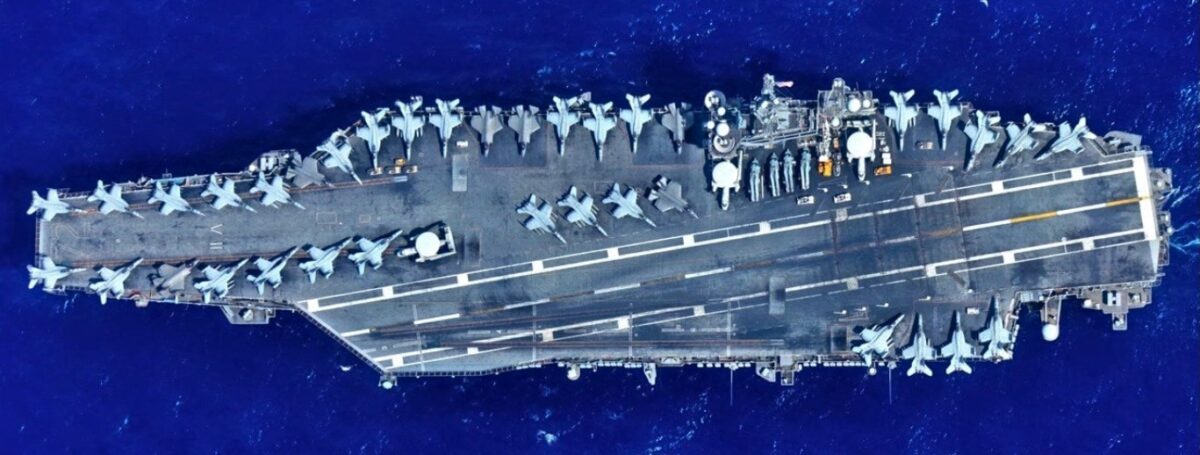
The Trump administration has now ordered a second Carrier Strike Group to join the one that is already sailing in the Gulf of Oman, close to Iran, and has deployed large amounts of military equipment (both offensive and defensive) to U.S. bases across West Asia, and to Israel. Trump’s envoys have now had two rounds of “proximity talks” with Iranian counterparts this month, discussing new limitations on Iran’s nuclear enrichment program.
Both sides have said those talks went fairly well. But Washington now expects Tehran to present more detailed plans by March 3 and Trump has warned that if Iran fails to reach a satisfactory agreement, then it will face very serious military consequences.
Some analysts have gauged the probability of an all-out war at “80 to 90 percent.” Such numbers are still wildly speculative (and personally I would peg them far lower than that.) But in assessing the possibility of any major military engagement between the U.S.-Israeli alliance and Iran it is crucial also to assess the range of outcomes and knock-on effects that we can plausibly foresee from any such conflict, at a number of different levels:
- within the immediate theater of the conflict (Iran, the Gulf region)
- in the Mashreq (Levant) region which has Israel at its geographic core, and specifically, on Israel’s ability to continue imposing its diktat on its neighbors in the region, and
- on the stability and integrity of the global system as a whole.
In this essay, I shall review the record of the project to weaken or topple Iran’s current, 47-year-long system of governance that the Trumpists and the government of Israel have jointly pursued in the period since Trump’s victory in the 2024 election, and identify six key takeaways we can take from that review.
In a later essay, I plan to build on this analysis to provide a few preliminary guidelines for what the effects of any new Trump-Israel assault on Iran might be, at the three levels identified above.
Tracking the Trump-Israel plot against Iran
Continue reading “The U.S.-Israeli plot against Iran: The record of the past 15 months”The US-Israel war on Iran: Takeaway #2, the China-Iran angle

Very few people in the ‘West’ have yet paid much attention to the very significant contribution that China has made, behind the scenes, to strengthening Iran’s resilience as well as its defensive and offensive military capabilities.
Several Western reporters have written (e.g., Reuters here) about China’s heavy degree of reliance on oil imports from Iran, and many of them have noted that this has made China very vulnerable to any closure of the Straits of Hormuz that could have been sparked by a continuation of the US-Israel war on Iran. But very few Western commentators have taken note of the fact that on May 24, a lengthy freight train carrying electronics and other goods arrived in Tehran, having inaugurated the first ever direct rail link between China and Iran.
Establishing this direct rail link is not the only way in which China has been bolstering Iran’s resilience and capabilities. Of probably even greater importance has been the ability Chinese tech has given many core parts of Iran’s governance and military command systems to free themselves from reliance on the kinds of Western tech that have left users often fatally vulnerable to US-Israeli hacking. As the well-placed Chinese tech expert William Huo noted earlier today, “Iran’s drones… fly coordinated, autonomous, and lethal. That’s Chinese targeting AI and optical systems… Iranian missiles run on Chinese chips, Chinese servos, Chinese nav units.”
He noted that in return, “China gets a combat-proven proxy and real-time telemetry from a U.S.-backed target. If Iron Dome can’t keep up, what happens in Taiwan? What happens to Aegis? To Japan’s missile net? Everyone watching saw the same thing… “
Small surprise, therefore, that earlier today, per Al-Monitor, “China hosted defence ministers from Iran and Russia for a meeting in its eastern seaside city of Qingdao…”
Huo and others have noted that much of the terminal guidance that made Iran’s most advanced missiles, and some of its drones, so effective in reaching precise targets inside Israel, was provided by systems using China’s Beidou navigation system (intriguingly often shortened to ‘BDS’.) Unlike systems reliant on the Western GPS system, BeiDou is not vulnerable to US/Israeli hacking or spoofing.
Evidently, some leading people in Iran’s security sector were still, as of June 13, using Western-based communications systems like WhatsApp or Telegram. Earlier this week, a Washington Post reporter was passed, by “an Israeli individual who obtained the material” an audio recording of a threat that an Israeli security-services operative had delivered over the phone to a “senior Iranian official” warning that he and his wife and family would be murdered unless he either fled Iran or made and sent back to them within 12 hours a video in which he dissociated himself from the Iranian government.
Almost certainly, going forward, all senior Iranian officials will be restricted to using non-Western means of communication.
China’s ability to have started building valuable, concrete operational relations with many parts of the Iranian military should come as little surprise. Back in March 2023, Chinese Foreign Minister Wang Yi stunned the whole of the Western world when he succeeded in brokering a reconciliation between Saudi Arabia and Iran that changed the geopolitics of the Gulf region and West Asia very substantially.
Prior to that reconciliation, it was an unquestioned assumption of most Western policymakers that the wealthy (and Sunni Muslim) rulers of the Arabian Peninsula coast of the Gulf more or less shared their desire to see the demise of the (Shi-ite-dominated) Islamic Republic of Iran. During the whole of the current US-Israeli attack against Iran, however, the Arab Gulf rulers of the GCC have largely stood aside from joining the anti-Tehran battles, though Qatar and many of the others do still host significant US military bases. At the June 22 meeting that the UN Security Council convened urgently to discuss the US-Israel-Iran crisis, the ambassador of Kuwait put his name on the speaker’s list and in the name of all members of GCC he decried the Israeli and US attacks on Iran and called urgently for a ceasefire.
On recent developments in China’s policies toward Palestine and West Asia more generally, here are two other intriguing sources:
- This piece by Zhang Sheng in Mondoweiss in March. (This tracks how, despite the PRC government’s fairly close economic ties with Israel some years ago, it has more recently distanced itself from it.)
- English translations of the speech the Chinese rep at the UN made at the June 22 session, and comments by a Ministry of Foreign Affairs spox, also on June 22. Interestingly, the Ministry spox noted that Chinese bodies had worked to evacuate 3,125 Chinese nationals from Iran during the war, while “China’s Embassy in Israel helped and organized the evacuation of over 500 Chinese nationals from Israel to safety, and helped some nationals from the UK, India and Poland safely evacuate.” So that is ratio of about 6 to 1.
The West’s domination of the Rest needs to end. (Part 1.)
Author Posted on Categories China, Diplomacy, Gaza, Global balance, Global governance, Uncategorized 
In Gaza today, we see Israel’s cruel, violent, and always ‘West’-backed military working overtime to snuff out the existence of the Palestinians in Gaza and the West Bank, two areas that have always formed a key part of Palestinian national territory. This phenomenon is not new in the lengthy record of the actions that heavily armed, West-European-origined settler cohorts have taken against the Indigenous people of lands far from the shores of Western Europe. Indeed, it replays with disturbing accuracy the actions that violent Portuguese, Spanish, English, Dutch, and French adventurers took over the past 500 years against Indigenes in the Americas, Africa, Asia, Australasia.
But today, everyone worldwide can see this latest massacre of the Indigenes taking place in all-color video, in near-real time.
That vast, non-‘Western’ majority of humankind whose ancestors were the survivors of earlier White-Western settler rampages well understands what is going on, and stands aghast at the continuing, barbaric cruelty of the Israeli government and military– and also at the active complicity of the U.S. and many/most other Western governments. (Many citizens of those complicit Western countries are also aghast at the massacre in Gaza, though a disturbing proportion of them– of us– have been cowed, silenced, and blackmailed by the endless repetition of old tropes about the need for Westerners and others always to “support Israel.”)
It is ways past time for all of this– above all, the massacres themselves, but also the complicity and the silence– to end.
I have been actively calling, since early November 2023, for the United States to step aside from the lockhold it has exercised since 1990 (or earlier) on all dimensions of Arab-Israeli “peace-making.” By wielding this lockhold, successive U.S. presidents have not just allowed but also actively supported Israel’s continued suppression of Palestinian rights, its force-backed takings of Palestinian and Syrian territory, and its repeated wars against neighbors.
At the end of that earlier essay I noted that in 1956, an earlier U.S. president, Dwight Eisenhower, had intervened against the British, French, and Israeli governments to force them to reverse the large-scale land-grab they had just undertaken against Egypt. And Eisenhower achieved that laudable goal not through military action (though he had earlier been been a forceful and effective military commander.) Rather, he did it by using only economic pressure, flexing just a small portion of the dominance the United States enjoyed in the world economy back then, to bring those three aggressive rogue states to heel. (Tragically, their Tripartite Aggression of 1956 had harmed not only numerous Egyptian military and civilian installations but also the always vulnerable, overwhelmingly civilian population of Gaza, who also stood in Israel’s way…)
In my essay I noted that just a few days later, in mid-November 2023, the leaders of the United States and China would be meeting in San Francisco. And I asked whether that meeting might see some efforts to restore oversight over Arab-Israeli peacemaking to the United Nations, where it rightfully belongs, and to end the (sharply pro-Israel) U.S. oversight of that diplomacy.
That did not happen then, and it hasn’t happened since– despite so many of us having continued to call, with increasing urgency, for the world powers to decisively END the political protection and the active support that Washington and its minions have given to Israel’s genocide in Gaza.
Like the vast majority of other governments around the world, the People’s Republic of China has been strongly critical of that genocide since the beginning, as it had been of Israel’s many other violations of international law against Palestinians and others, for many decades prior. But Beijing has still taken zero visible or effective action, of the kind that Eisenhower took back in 1956, to rein in the US-Israeli assault on Gaza and push Israel back to its recognized international border.
In March, researcher Zhang Shen published this excellent analytical essay about China’s policy on Palestinian, in Mondoweiss. In it he wrote,
The seemingly promising bilateral [trade-focused] relationship between China and Israel from 2015 to 2020, once created some voices, both within Chinese and Israeli society, calling for a deeper strategic cooperation between the two states. Yet, what happened on 7 October 2023, and in particular the Israel bombardment of Gaza that followed, irreversibly destroyed the possibility of business as usual.
Right after 7 October, the Israeli government demanded China condemn Operation Al-Aqsa Flood and to list Hamas as a terrorist organization, but unsurprisingly, China refused this demand. The Chinese government does not accept the Western-Israeli narrative that portrays 7 October as the start of history. Instead, China sees it as one of the many tragedies of the prolonged “Arab-Israeli conflict” inherited from British colonial rule. The PRC, as a regime that emerged out of Mao’s strategy of “people’s war,” guerrilla warfare, and anti-colonial armed struggle, remains inherently sympathetic toward other guerrilla forces of the Global South.
But still, until now, the PRC government has taken no concrete steps to end Israel’s genocide in Gaza or to challenge the “ironclad” protection and support that Washington has given to the génocidaires.
I guess there are a number of possible explanations. Maybe the CCP’s leaders do not care enough about what’s happening to Palestinians in Gaza to try to take action? Or– and this I find more likely– maybe they care very deeply but are still for a number of reasons wary of confronting Washington over an issue that, as they must understand, the powers-that-be in Washington have long judged to be of central importance to them.
Whether, when, and how, we might see some change in these judgments in Beijing (or, more accurately, in the well-guarded Zhongnanhai enclave where CCP leaders hold their most important conclaves) is what I’ll be exploring in the remaining portions of this series.
This is a matter of impact far beyond the misery-soaked ruins of Gaza. That tiny enclave is now the epicenter of the “last gasp” of the White/Western supremacist worldview that has dominated world affairs for the past four-plus centuries. What happens there matters to all of humanity.
China displays its chops in tech, mil-tech, manufacturing– and even political philosophy…


On April 2, Pres. Trump launched a super-harsh economic “war” against China, slapping on the country a harsh initial round of his tariffs that by April 9, after two rounds of reciprocal raises, had reached the level of 145%. By April 11, China’s reciprocals had reached 125%, and Beijing also announced a ban on exports of a broad range of rare-earth minerals and their derivatives.
Trump said throughout that he was waiting for China– and all the other countries on which, with extreme folly, he had also slapped tariffs of a range of harshness– to call him and start negotiating. Pres. Xi didn’t call. Trump blinked first and early, saying Oops he wanted to exempt computers and iPhones. But he also announced punishing new fees on all China-linked vessels to use U.S. ports.
Pres. Xi still hasn’t called, while there are several signs that Trump is increasingly eager to pick up the phone himself and start offering non-trivial concessions.
The two countries are thus far in an economic-warfare standoff that, as many participants in the IMF/World Bank’s Spring Meetings this week have warned, threatens to plunge the U.S. economy and a large chunk of the rest of the world economy into a deep recession.
I thought it would be a good time to take a deep dive into what China’s manufacturing and international-trading capabilities (and vulnerabilities) actually are…
But the journey I took in order to explore those topics took me to some extremely intriguing areas I had not expected when I first set out…
Continue reading “China displays its chops in tech, mil-tech, manufacturing– and even political philosophy…”For the commanders of Western hegemony, cruelty is a vital tool
Author Posted on Categories China, Global governance, Indian Ocean, Israel, Settler colonialism, U.S. policy 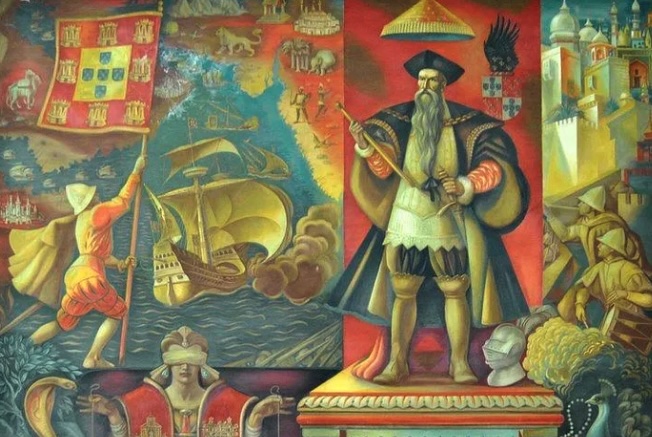
The painting above is of Portuguese conquistador Afonso de Albuquerque
For Pres. Trump, cruelty is a vital tool as he bulldozes through all constitutional requirements to undertake (and publicize) exemplary deportations of undocumented immigrants and of any legally documented visitors like Columbia University’s Mahmoud Khalil whom he arbitrarily chooses to punish.
For Israel’s PM Netanyahu and his ministers, cruelty is similarly a vital tool as they deploy waves of bombers and incendiary drones against two million Palestinians huddling under tarps on Gaza’s trash-piled shores while totally blocking the entry into Gaza of all the basic necessities of life.

It’s worth noting that cruelty has been a vital, and deliberately deployed, tool for the architects and commanders of “White” empires ever since the 15th century CE. In 1415, Portuguese navigators started carving their way down the coast of West Africa to establish heavily fortified “trading” (plunder) posts in their quest for gold. Those navigators were also intent on finding a sea-route to the richest trading zone they’d ever heard of, the one that traversed the Indian Ocean and wove the riches of East Africa, India, and distant Cathay (China) into the most advanced manufacturing and consumption area then known to humankind…
Continue reading “For the commanders of Western hegemony, cruelty is a vital tool”
The Red Sea in history and today

I was planning to write a quick essay here about how the Houthis’ robust pro-Gaza-ceasefire actions in the Red Sea have further strengthened the already clear (can we say “ironclad”?) tie-up between Israel’s ongoing genocide in Gaza and the massive shifts now underway in the balance of global power.
I will get to that a little more, below. But meantime the confrontations in the Red Sea and the adjacent Gulf of Aden seem to be escalating—along with the tensions between the U.S. ground/expeditionary forces at the crucial confluence of the Syria-Iraq-Jordan borders, where on Sunday, local anti-U.S. militias killed three U.S. service-members and injured dozens more in a drone attack.
In the global diplomacy over Gaza, much attention has been paid to the (not notably successful) missions that Sec. of State Blinken and CIA Director Bill Burns have been undertaking to try to win that ever-elusive Gaza-Israel ceasefire. Much less attention has been paid to the trip that Biden’s National security Advisor Jake Sullivan made to Bangkok last Friday, where he met with top PRC diplomat Wang Yi to try to persuade Wang to pressure Iran to rein in the Houthis’ actions in the Red Sea.
Continue reading “The Red Sea in history and today”