

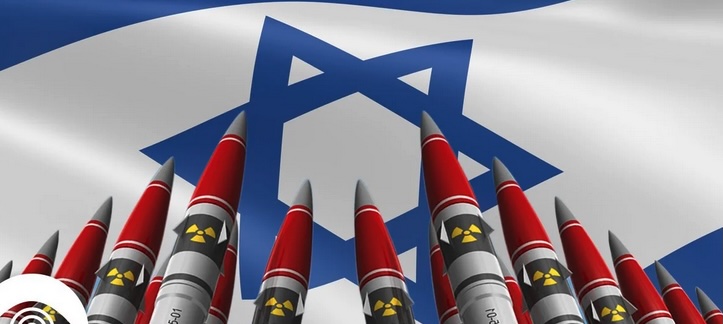
One thing the current Israeli-U.S. war is not about is the (completely unsubstantiated) accusation that “Iran is close to having a nuclear weapon.” One thing it actually is about is the well-substantiated fact that in West Asia it’s Israel that has a robust nuclear arsenal— and that the contortions that all of the U.S. policy elite has gone through for decades now to obfuscate this fact have done a lot to push Washington into its present, world-impacting war against Iran.
Back in the 1950s it was the French government, as well as several well-placed individuals inside the U.S. nuclear-weapons complex, who helped Israel attain the technology and materials it needed to develop its own production of nuclear weapons, which it achieved shortly before its PM Levi Eshkol launched the “Six Day War” against three surrounding Arab states in 1967. (A footnote: that war was also associated with a decision— in that case, by Egypt— to close a key waterway.)
But from then until today, Israel’s leaders have always shrouded its possession of nuclear weapons in a deliberate policy that they call amimut (opacity.) I recall, in the late 1980s, attending several sessions of well-meaning “Track Two” discussions on “nuclear weapons in the Middle East” in which Yehoshafat Harkabi and other key Israeli decisionmakers/experts, along with experts and analysts from Egypt, Europe, and the U.S. all took part.
Harkabi was a true expert of projecting obfuscation!
This policy of deliberate obfuscation was also extremely well developed and maintained among all key branches of the U.S. policy elite. Especially the corporate media, but also all branches of the government, at all levels. A person could very easily get tarred as an “Israel-hater” or an “anti-semite” if she/he dared mention publicly the fact, or even the suspicion, that Israel commanded a weighty nuclear arsenal at the same time that its leaders and supporters around the world were frantically pointing fingers at Iraq, Syria, Iran, or Libya for their supposed dedication to attaining a “the bomb.” (Of those, only Libya ever came close. But in 2003, Pres. Qadhafi unilaterally and verifiedly ended the program. As for Iran, for many decades now the country’s successive Supreme Leaders have repeatedly stated that it is against their religion and their policy to attain nuclear weapons.)
Continue reading “Cracking the U.S. taboo around Israel’s nuclear bombs”