War on Iran: Global consequences and off-ramps we should support

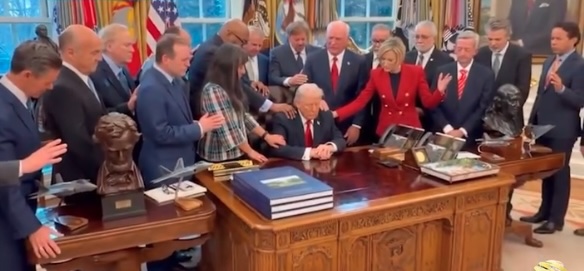
(The photo shows Trump being prayed over in the White House yesterday by a group of evangelical pastors.)

Today is Day 7 of this mass-murdering, mass-destruction project that Pres. Donald Trump named “Operation Epic Fury” (OEF). Already, the dimensions of many of its (quite foreseeable, and by many people clearly foreseen) consequences are becoming evident.

Most crucially, as of today, these:

  • The Iranians’ governance and command structure has survived, despite “decapitation” strikes since its first hours that killed Supreme Leader Khamene’i and dozens of top commanders.
  • Iranian forces continue, in response to OEF, to undertake stand-off attacks that seem well aimed and well coordinated and have in many cases inflicted real damage on their intended (military and economic) targets.
  • Israel has exploited this situation of war, impunity, and lawlessness to (a) reimpose its super-tight siege on the two million people of Gaza, (b) sharply escalate its bombings of Lebanon and peremptorily order the ethnic cleansing of South Lebanon as well as Beirut’s densely populated southern suburbs, and (c) continue to oppress and dispossess Indigenous inhabitants of both the West Bank and Syria.
  • The Iranians’ response to OEF has included attacks not just on Israeli and U.S. military bases across West Asia but also on key economic facilities in Arab Gulf countries.
  • Through those latter attacks and by closing the Straits of Hormuz to shipping from OEF-associated countries, Tehran has delivered a huge blow to the global economy and especially to the Gulf Arab states that have been major bankrollers of Trumpian projects worldwide.

There are still, as of now, no signs of any imminent collapse of Iran’s command/governance structure. And meanwhile, all around the world a chorus of questions is growing louder around two key issues, either of which could rapidly increase the pressure on Washington to end the war. The first such pressure-point is the durability of U.S. stockpiles of key missile-defense and air-defense munitions needed to fend off Iran’s continuing volleys of low-cost drones and high-altitude missiles. The second is the degree, speed and temporal extent of the damage that the war inflicts on the global economy– a process that has already started.

Continue reading “War on Iran: Global consequences and off-ramps we should support”

The U.S.-Israeli plot against Iran: The record of the past 15 months

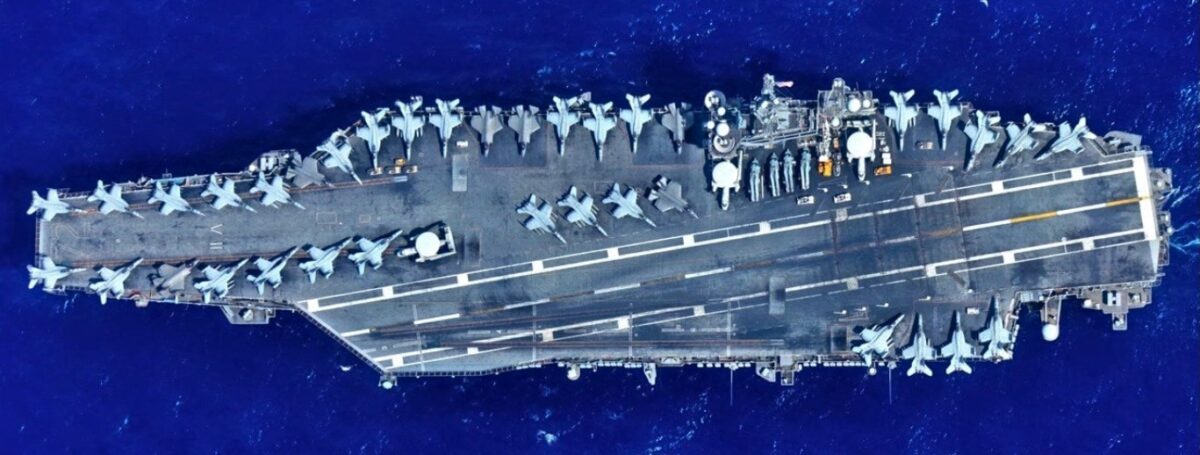
The Trump administration has now ordered a second Carrier Strike Group to join the one that is already sailing in the Gulf of Oman, close to Iran, and has deployed large amounts of military equipment (both offensive and defensive) to U.S. bases across West Asia, and to Israel. Trump’s envoys have now had two rounds of “proximity talks” with Iranian counterparts this month, discussing new limitations on Iran’s nuclear enrichment program.

Both sides have said those talks went fairly well. But Washington now expects Tehran to present more detailed plans by March 3 and Trump has warned that if Iran fails to reach a satisfactory agreement, then it will face very serious military consequences.

Some analysts have gauged the probability of an all-out war at “80 to 90 percent.” Such numbers are still wildly speculative (and personally I would peg them far lower than that.) But in assessing the possibility of any major military engagement between the U.S.-Israeli alliance and Iran it is crucial also to assess the range of outcomes and knock-on effects that we can plausibly foresee from any such conflict, at a number of different levels:

  • within the immediate theater of the conflict (Iran, the Gulf region)
  • in the Mashreq (Levant) region which has Israel at its geographic core, and specifically, on Israel’s ability to continue imposing its diktat on its neighbors in the region, and
  • on the stability and integrity of the global system as a whole.

In this essay, I shall review the record of the project to weaken or topple Iran’s current, 47-year-long system of governance that the Trumpists and the government of Israel have jointly pursued in the period since Trump’s victory in the 2024 election, and identify six key takeaways we can take from that review.

In a later essay, I plan to build on this analysis to provide a few preliminary guidelines for what the effects of any new Trump-Israel assault on Iran might be, at the three levels identified above.

Tracking the Trump-Israel plot against Iran

Continue reading “The U.S.-Israeli plot against Iran: The record of the past 15 months”

Why a set of treaties from 1648 CE is more important than ever

If you’ve never learned about the 1648 Peace of Westphalia, then now is an excellent time to do so. This set of treaties, agreed to by the leaders of more 100 little European statelets and dukedoms in an era in which the modern-style “nation state” was only just emerging, laid the ground rules for the international state system that has existed until today. Its core principle was the sovereign independence and equal standing of all states in the system.

That principle, as extended to and embraced by all the 193 states in today’s international system, lies at the heart of the Charter of the United Nations, as adopted in San Francisco in 1945. In Article 2, the UN Charter states clearly that:

(1) The Organization is based on the principle of the sovereign equality of all its Members…

(4) All Members shall refrain in their international relations from the threat or use of force against the territorial integrity or political independence of any state, or in any other manner inconsistent with the Purposes of the United Nations.

As we know, in the 80 years since 1945 many states have violated these principles of the Charter (and many others.) But the action the U.S. government took on January 3, sending military forces to violently blast their way into the home of the head of another sovereign state and to snatch him and his wife and take them to U.S. territory on a flimsy judicial pretext, has been among the most egregious and the most threatening to today’s whole system of international law.

Continue reading “Why a set of treaties from 1648 CE is more important than ever”

As the UN crumbles, what?

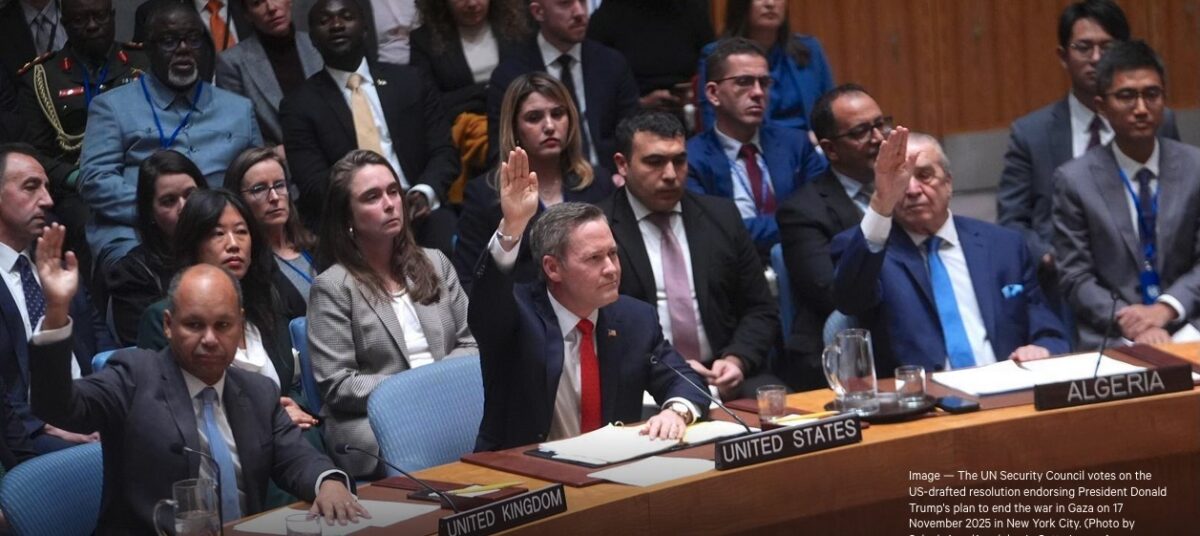
As someone born in the early 1950s, I have never known a world without the United Nations. But by adopting Security Council Resolution 2803 (text) on November 17, the 15 states that sit on the UN’s most authoritative body, the Security Council, have now knowingly given a green light to the genocidal American-Israeli assault on Gaza, in clear violation of all the norms and values on which the UN was founded.

Thirteen of those states (including four Muslim-majority nations) voted for the U.S.-presented resolution. China and Russia, either of which could have blocked it by wielding a veto, chose not to do so. It seems that all those 15 states are prepared to rip up the entire international “system” of which the UN is the linchpin, and to let the world crumble into a stew of “might-makes-right” anarchy.

Craig Mokhiber, the 30-year veteran of the UN’s human-rights system who resigned his post in late October 2023 when he accused the UN of having failed to prevent Israel’s already-underway genocide in Gaza, published a powerful and well-documented piece on Resolution 2803 on Mondoweiss November 19. It clearly laid out the many ways in which Resolution 2803 violated longstanding UN norms, including those enshrined in its 1945 Charter.

In a discussion with Ali Abunimah on the EI Livestream yesterday, Mokhiber developed his critique even further. He noted that Resn. 2803 gives Pres. Trump the sole authority, via his position as head of the grotesquely mis-named “Board of Peace”, to do anything he wants regarding the administration of Gaza. Mokhiber’s comment: “It’s not even colonial, it’s King Leopold-esque.” (That recalled the fact that during the grossly genocidal period of “Belgian” rule over the Congo, 1885-1908, that whole vast territory was being administered as the personal property of Belgium’s King Leopold II.)

Continue reading “As the UN crumbles, what?”

The status and meaning of Trump’s Gaza ceasefire deal

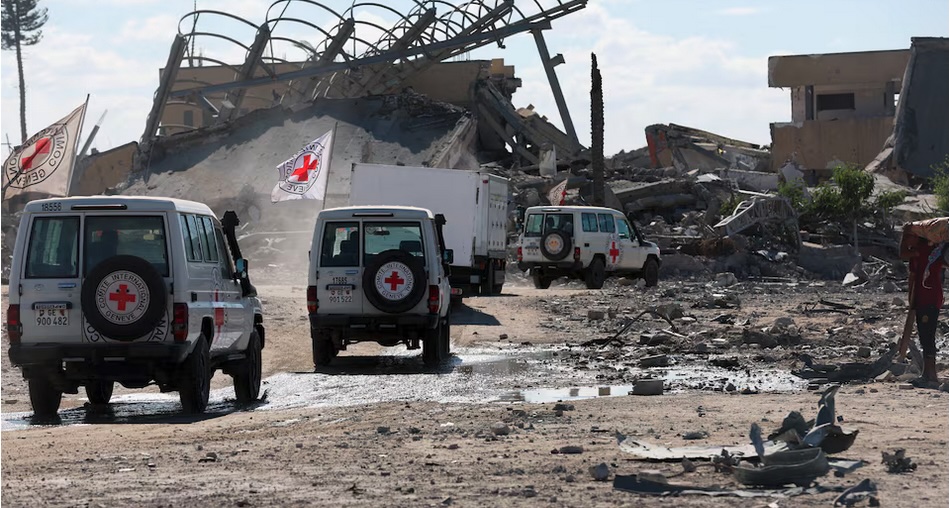
On October 10, the devastating bombings and other attacks that the Israeli military has undertaken against Gaza nearly continuously for the past two years finally came a halt. (Or nearly so, see below.) The Israeli military’s massive tanks and bulldozers began to lumber their way out of some– but far from all– of the parts of Gaza they had devastated over those 24 months. Some aid trucks started to roll in. Hundreds of thousands of the Palestinians who’d been forced, under withering Israeli fire, to evacuate south from Gaza City started to trudge back north to their former– very often completely pulverized– homes.

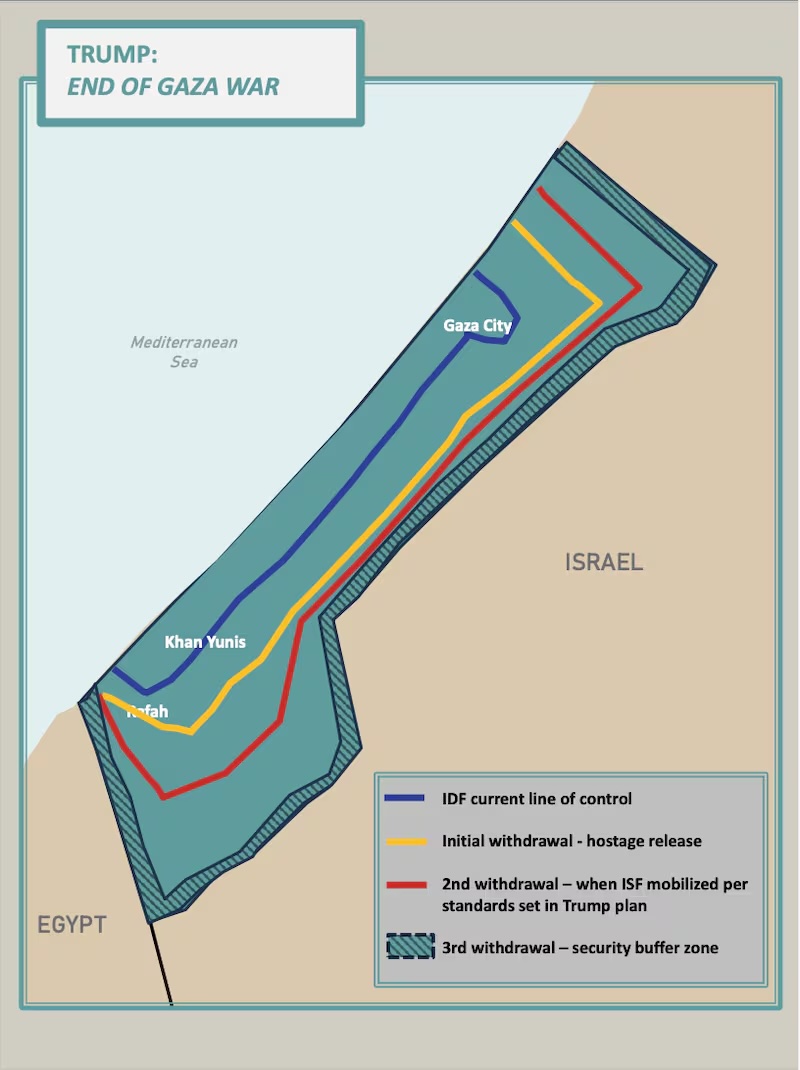
Phases of withdrawal in Trump’s plan. Source. Click to enlarge.

U.S. Pres. Trump was the one who successfully forced the Israeli government to sign onto that ceasefire agreement. (He could, at any moment since his inauguration back in January, have used Washington’s near-complete sway over Israel’s military decisionmaking to force that same outcome… And so, at any point in the preceding 15 months, could his predecessor in the White House. How many thousands of lives and destinies would have been saved?)

On October 13, as the reciprocal captive-exchange portions of the October 10 agreement were completed, Trump organized two large, splashy public events– one in Israel, one in Egypt– at which with his now horribly familiar braggadocio he took his victory laps for the ceasefire.

Continue reading “The status and meaning of Trump’s Gaza ceasefire deal”

Hamas in negotiations– and on the ground

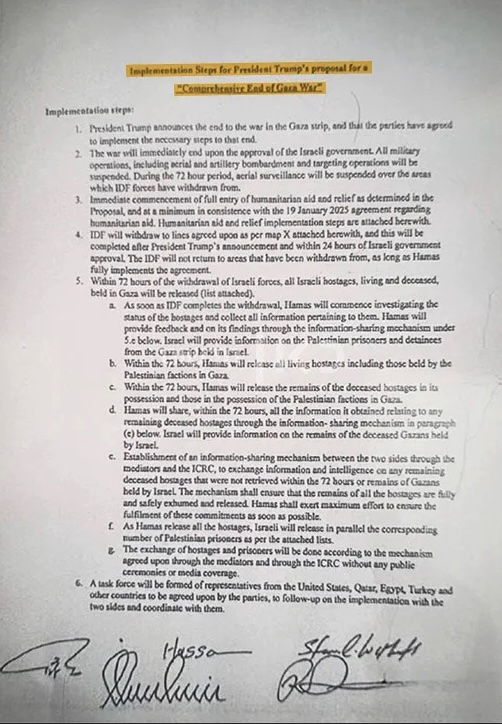
Text of Oct. 9 agreement. Click to enlarge.

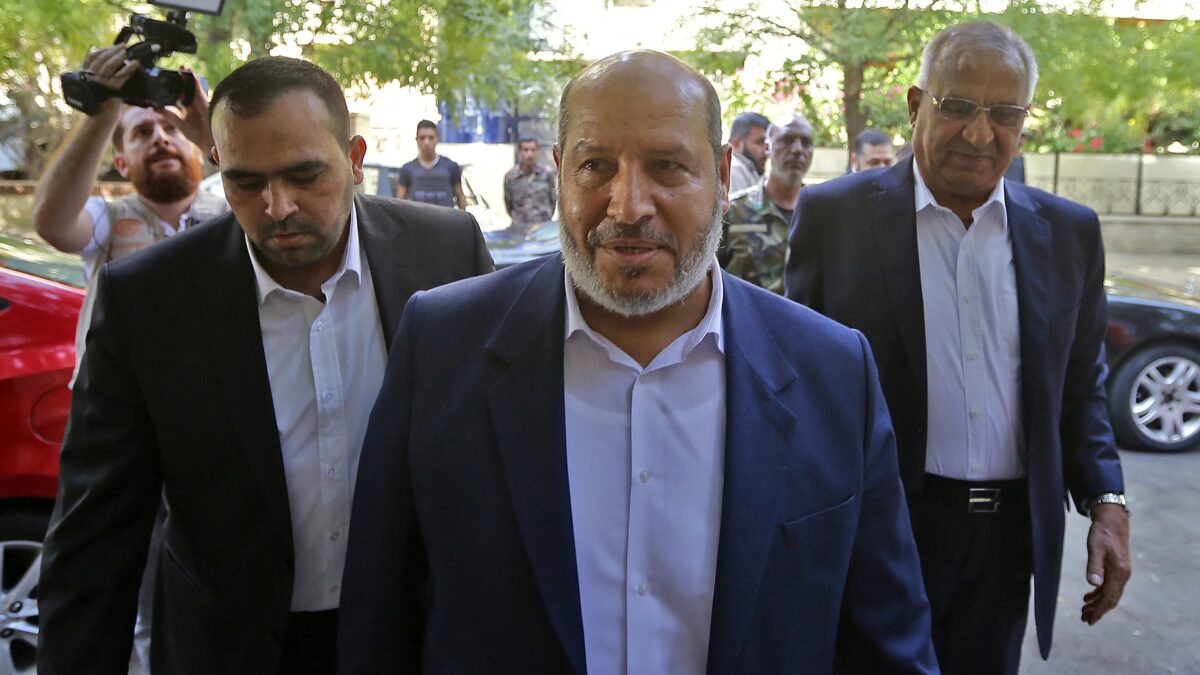
The clock started ticking at Noon Palestine Time today on implementation of the 6-step ceasefire + captive-release agreement negotiated in Sharm el-Sheikh, Egypt, by Pres. Trump and his three Muslim-state mediation partners. Those talks were held on a “proximity” basis with, presumably, the Israeli negotiators in one room, the Palestinian resistance alliance led by veteran Hamas negotiator Khalil al-Hayya in another, and various groups of mediators shuttling between them.

(That’s Khalil Al-Hayya, above.)

The negotiators in Sharm had reached agreement on their 6-step plan on Thursday, but per Step 2 therein, implementation awaited the approval of the Israeli government. That was achieved this morning.

The prescribed ceasefire and many signs of an Israeli military pullback started at Noon today (local.) By that time, thousands of Palestinians whom the Israelis had previously expelled south from Northern Gaza under fire were already streaming back toward their homes in the north.

Continue reading “Hamas in negotiations– and on the ground”

On ‘Condemning Hamas’

I was at an in-person event here in Washington yesterday, and I raised the matter of Hamas, noting that the title of Rami Khouri’s and my recent book Understanding Hamas And Why That Matters is still very relevant. One of the speakers was the Egyptian-American Washington Post columnist Shadi Hamid. He responded by making a few fairly smart observations– but then he loudly repeated the injunction that has been his watchword throughout the past two years: “We must condemn Hamas!”

I guess that is the price Hamid feels he must pay to have access to the pages of Jeff Bezos’s failing, but still influential, rag here in the U.S. capital. Maybe he even believes it. But why? What does it actually mean to “condemn” an entire movement– and one, moreover, with which our national government has been negotiating, with varying degrees of intensity, for more than 18 months now?

A movement, therefore, whose inner workings and worldview it would presumably be very useful for both government officials and informed citizens to understand as well as possible…

Continue reading “On ‘Condemning Hamas’”

A Jewish State in Palestine: The UN’s Original Sin?

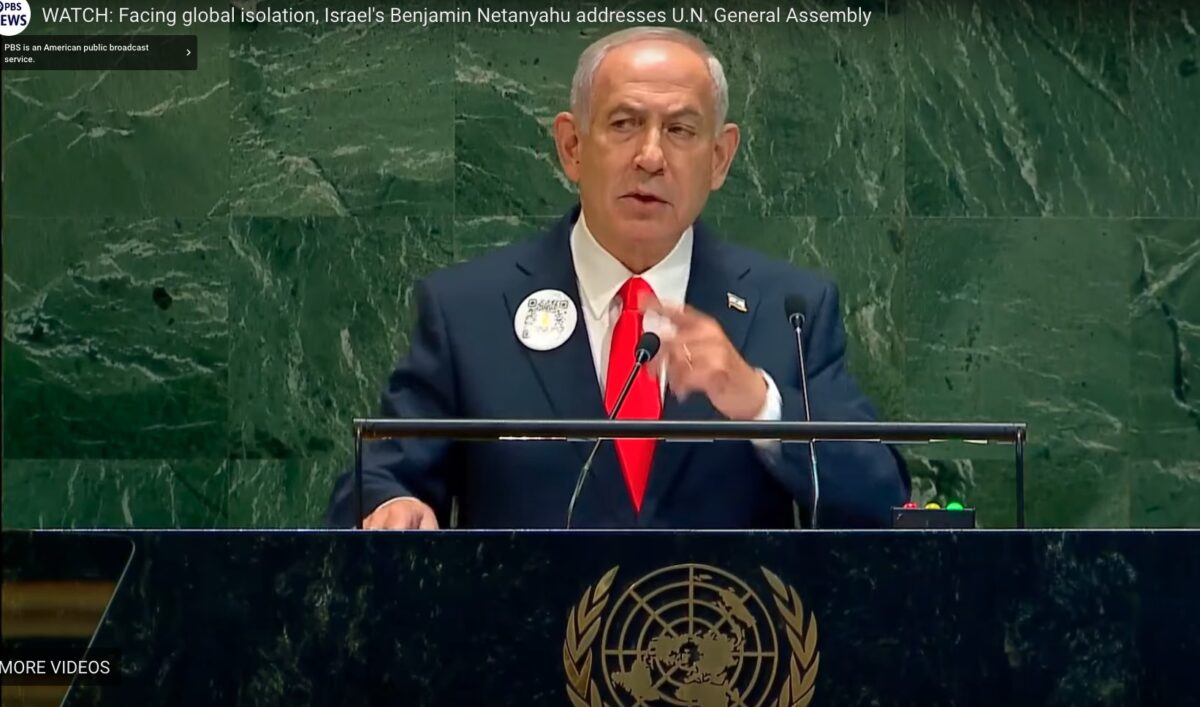
On a day when an indicted war criminal and the author and Kommandant of an ongoing genocide gets to speak from the rostrum of the world’s most august and authoritative governance body… We should ask whether this tradition of coddling and endlessly appeasing the leaders of a brutal settler-colonial project in Palestine dates back, indeed, to the founding years of the United Nations and the decision an earlier UN General Assembly took in November 1947 to partition historic Palestine and assign to that small proportion of its residents who were participants in the Zionist settler project, their own independent ethno-state state and to allocate to it, moreover, a wildly disproportionate amount of Palestine’s fertile land and other resources.

Today, at a time when Israel’s government and military continue their genocide in Gaza– and their ethnic cleansing in Jerusalem and the rest of the West Bank… and their continuing aggressions against Syria, Lebanon, Yemen, and even a small unarmed flotilla of humanitarian activists– we should ask whether this two-year-long orgy of Israeli violence is now bringing down not just the global power of its main backer in world affairs (whose own foundation as a “nation” lay also, lest we forget, in a settler-extremist rebellion against the metropole), but also the United Nations itself.

Continue reading “A Jewish State in Palestine: The UN’s Original Sin?”

Gaza, and the UN at 80

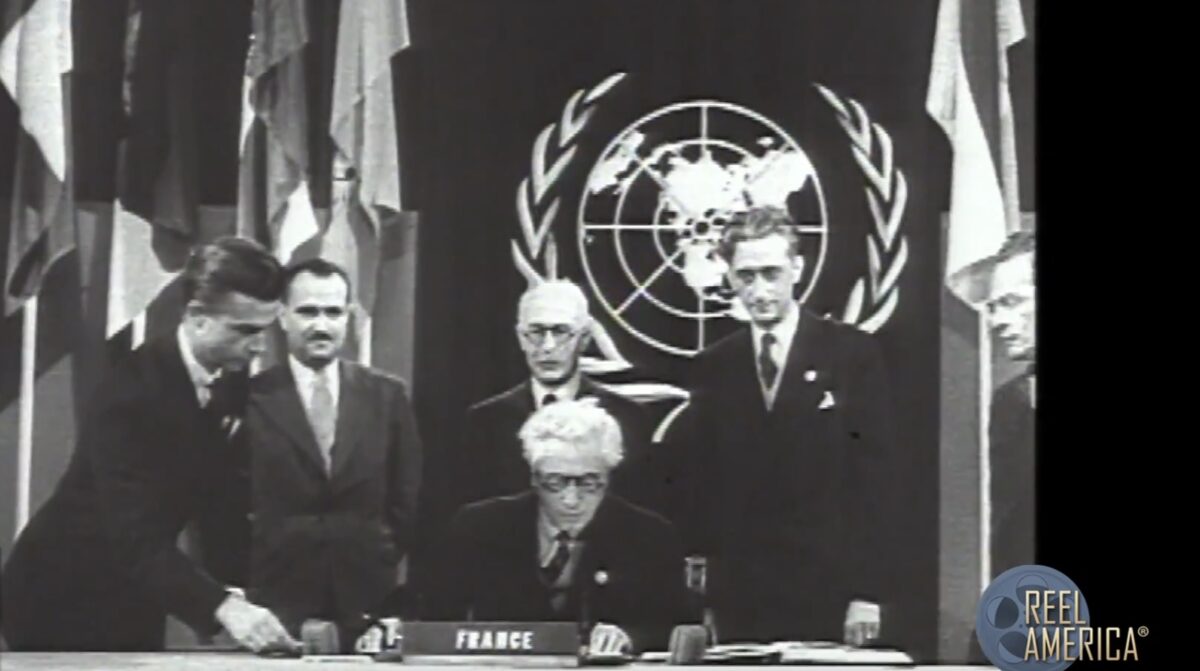
Above: A scene from the June 1945 signing of the U.N. Charter

For many decades now, Israel has acted as the tip of the spear for “White”, Western colonial domination of West Asia and much of North Africa. Through prodigious and focused efforts, Israel’s leaders so successfully meshed their military and technological elites with those of the United States that they achieved a large degree of control over U.S. actions in countries from Iran to Libya– including, of course, U.S. policy on the crucial Palestine Question.

The fully U.S.-backed genocide that Israel has pursued for the past two years in Gaza has echoed a lengthy string of similar actions that “White” colonial powers– including the United States–have enacted against Indigenous peoples on all continents for the past five centuries. In today’s largely post-colonial world, this genocide has thus provoked a tsunami of revulsion across (and beyond) the whole of the Global South. This has greatly reduced the appeal and “soft power” that, before October 2023, Washington was able to deploy in its conduct of world affairs. It has also thrust the 30-year-long, de-facto hegemony that Washington has exercised over the UN’s global-level decision-making into ever sharper question.

Israel’s genocide in Gaza and the international reaction to it are now seen by many as marking the beginning of the end of the lengthy domination that “White”, European-origined governments have exercised for many centuries over much of the Global South.

We should note, too, that during this genocide Israel’s leaders have harshly attacked not only the steps that various bodies of the now 80-year-old United Nations have taken to end or temper the genocide, but also the foundations of UN legitimacy itself. They have thus presented the post-1945 world system with the greatest challenge it has ever seen.


Last June saw the 80th anniversary of the signing in San Francisco of the UN Charter by the leaders of all 51 of the world’s then-recognized independent governments. (That was before the dismantling of the large, globe-girdling European empires. Today, the UN has 193 members.) This September will see the opening of the 80th annual session of the UN General Assembly (GA). At this year’s GA more questions than ever before will be raised about the dysfunctionality of the UN rule that has allowed Washington to repeatedly wield its veto in the UN Security Council to block the Council from acting to end Israel’s genocide in Gaza, or to end Israel’s many other gross violations of international law across West Asia.

Continue reading “Gaza, and the UN at 80”

Palestinian statehood and international legitimacy

The recent announcements by the governments of France and the U.K. that they have some (limited) readiness to “recognize” a Palestinian state change nothing– either regarding the genocide in Gaza or in the diplomacy over the Palestine Question more broadly. What they do do, however, is highlight once again the debate that has long simmered within the Palestinian-rights movement over whether the goal of the Palestinian movement should be a fully democratic one-state situation (‘solution’) or a two-state situation in which Palestinian and majority-Jewish Israeli states co-exist side-by-side in the land of historic (Mandate-era) Palestine.

But maybe now is a good time to re-examine another formula that’s been on the table for nearly 80 years now: that of, effectively, the three-state situation prescribed by the Partition Plan for Palestine as defined in the UN General Assembly’s Resolution 181 of November 1947?

That 1947 Partition Plan is, after all, the only authoritative and geographically delineated plan for governance in historic Palestine that carries the imprimatur of the UN and thereby its certificate of international legitimacy. And we should all care about international legitimacy, right?

Continue reading “Palestinian statehood and international legitimacy”