

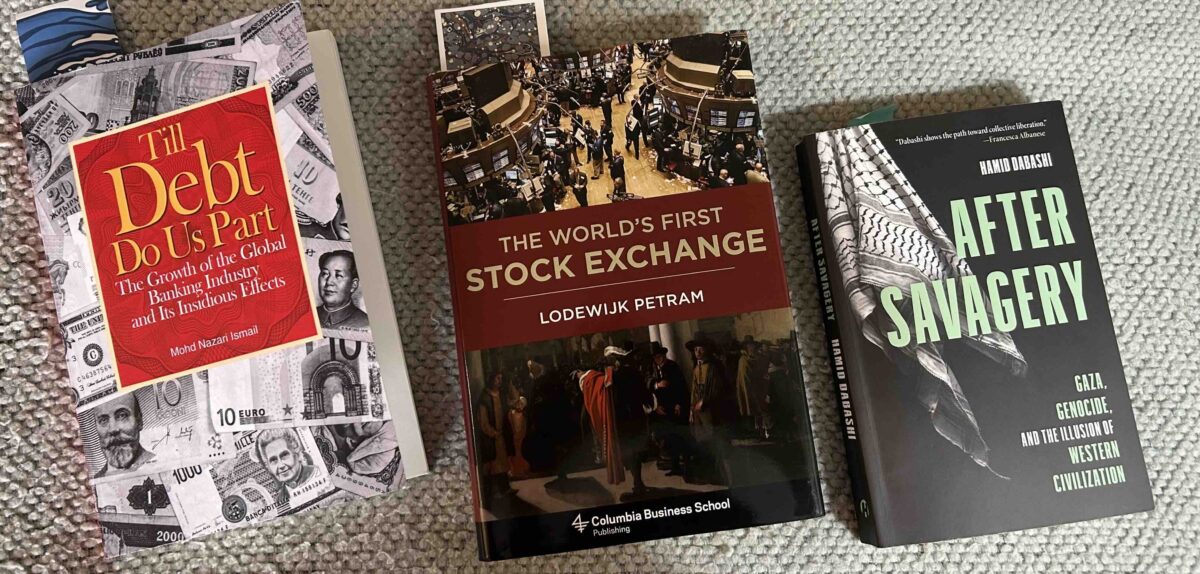
I’ve been reading Hamid Dabashi’s thought-provoking new book After Savagery: Gaza, Genocide, and the Illusion of Western Civilization. It is a very useful documentation of, and reflection upon, the extreme savagery of Israel’s (still-ongoing) genocide in Gaza and also, importantly, what the very active support that many “Western” nations have given to this genocide tells us about the culture or “civilization” of the West. Throughout the book, Dabashi provides long excerpts from both the poignant “resignation letter” on Gaza that the former UN human rights official Craig Mokhiber penned to his UN bosses in late October 2023, and Sven Lindqvist’s landmark 1992 book ‘Exterminate All the Brutes’: One Man’s Odyssey into the Heart of Darkness…
I heartily recommend that everyone read Dabashi’s book, but I have a couple of quibbles. One is just to note that we are by no means yet “After” the savagery of Israel’s genocide in Gaza. If I were publishing the book I would have urged another title, such as In a Time of Savagery… I have also seen news of a book by Pankaj Mishra titled The World After Gaza, which has received mixed notices. But the world is decidedly not yet “after” Gaza, or Israel’s pursuit of savagery therein!
I think what we can say at this point, even as Israel’s savagery in Gaza continues, is that the first two years of the genocide and the behavior of various world powers during those years have already provided humankind with a shockingly rich trove of evidence about the savagery of this Israeli government, of the Zionist political project of which it is a product– and of those “Western” and other powers that have actively aided the genocide.
And who know what more the coming months or years will reveal about these matters?
My other quibble with Dabashi’s work is that, though he does a little to explore the phenomenon of Zionism as an example of Western settler colonialism, I wish he had delved into this aspect a lot more deeply. It’s true that his Chapter 2 provides some valuable signposts to this strand of the story. And on p.127, he intriguingly recalls that, “the birth of European democratic modernity was coterminous with Europe’s colonial age of conquest.” But just noting this synchronicity is, I believe, far from sufficient. Surely, we also deserve an explanation of the degree to which the plentiful takings that European merchants, speculators, and rulers were able to steal from the colonized peoples actually financed the economic development in the societies of the various European metropoles that allowed that “birth of European democratic modernity”?
Later, p.155, he notes, “The myth and the illusion of ‘the West’ has ended in ignominy, buried forever under the rubble of Gaza. The West was an ideological invention of globalized capitalism…” I think his first judgment there is a sound one, though I’m not yet sure of that. But his second proposition deserves a lot more explication… I don’t have time to provide a full explication here. But I have also been reading a thought-provoking book on a topic closely related to Dabashi’s consideration of the historical longue durée of the relationship between settler colonialism and the emergence of capitalism. This is Till Debt Do Us Part: The Growth of the Global Banking Industry and its Insidious Effects, by Malaysian thinker Mohd Nazari Ismail.
On pp.22-23 of his book, Nazari Ismail notes the key role played in the emergence/development of (often speculative) finance capitalism by the emergence of joint stock corporations, and then by the establishment of the stock exchanges in which shares in those corporations could be more or less freely traded. However, he dates the emergence of stock exchanges only back to the founding of the one in London, which he dates to the 1770s. If he had cast his eyes over the North Sea to Amsterdam, however, he would have found a stock exchange there whose establishment (a) was significantly earlier than the one in London, and (b) was inextricably tied to the establishment of the Dutch East-India Co0mpany (VOC), a joint-stock corporation that merchants in six Dutch cities set up in 1602 CE to conduct (extremely rapacious) trade with trading centers in and around the Indian Ocean.
In 1602, the VOC received a charter from the Dutch parliament that gave it a 21-year monopoly (renewable) to conduct this trade. (This “monopoly” protected the VOC only from competition by other Dutch entities, and was in no way respected by traders based in other West-European metropoles.) Crucially, the VOC’s charter– like the charter that England’s East India Company received, in 1600 CE, from Queen Elizabeth I– allowed it to pursue whatever military operations it needed in order to enforce its preferred terms of trade on the Indigenous peoples of the areas in which it operated.
But the VOC’s charter also made clear that shares in its corporation could be freely traded among residents of the six Dutch cities in which it operated, of which by far the most important was Amsterdam. And very soon after the VOC’s founding such trading began in earnest. Dutch historian Lodewijk Petram gives a lively description of how all that happened in a 2011 book, which was translated into English as The World’s First Stock Exchange.
Why is all this important? It seems to me very helpful to establish the close connections between all the following phenomena:
- Zionism in thought and practice, and the history of other Western settler colonialisms throughout the Global South;
- The crass, racist, and anti-humane brutality of all those colonial projects;
- The role that settler-colonial booty played in underwriting the emergence of “capitalist modernity” in the West-European metropoles;
- The ties between the anti-humane nature of the the various “Western” settler-colonial projects and the frequently anti-humane nature of capitalism itself, especially in its more hyper-financialized forms;
- The role that the establishment of major settler-colonial projects based in the “Protestant” heartlands of Netherlands and England/Britain played in the emergence of heavily financialized capitalist systems in those polities, and later in other parts of Europe and in English/British offshoots like the USA, Canada, or Australia;
- The role that Western-origined financial institutions like the big Western banks or the IMF or have played over the past century in continuing the economic looting of the resources of countries of the Global South; and
- The continuing and perhaps growing threat that the hyper-financialization of “Western” economies poses to the peoples of these countries, too.
… And maybe it’s also useful to return to the response that Mahatma Gandhi may (or may not) have given back a century ago, when he was asked what he thought of “Western civilization” and his answer was, “I think it it would be a good idea.” Indeed.
