

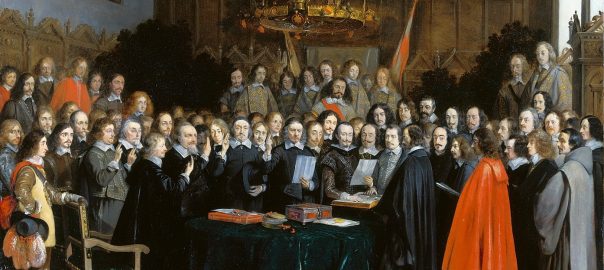
If you’ve never learned about the 1648 Peace of Westphalia, then now is an excellent time to do so. This set of treaties, agreed to by the leaders of more 100 little European statelets and dukedoms in an era in which the modern-style “nation state” was only just emerging, laid the ground rules for the international state system that has existed until today. Its core principle was the sovereign independence and equal standing of all states in the system.
That principle, as extended to and embraced by all the 193 states in today’s international system, lies at the heart of the Charter of the United Nations, as adopted in San Francisco in 1945. In Article 2, the UN Charter states clearly that:
(1) The Organization is based on the principle of the sovereign equality of all its Members…
(4) All Members shall refrain in their international relations from the threat or use of force against the territorial integrity or political independence of any state, or in any other manner inconsistent with the Purposes of the United Nations.
As we know, in the 80 years since 1945 many states have violated these principles of the Charter (and many others.) But the action the U.S. government took on January 3, sending military forces to violently blast their way into the home of the head of another sovereign state and to snatch him and his wife and take them to U.S. territory on a flimsy judicial pretext, has been among the most egregious and the most threatening to today’s whole system of international law.
Pres. Trump and his cabinet compounded that violation by proclaiming that,after this kidnap operation the United States would “run” the entire country of Venezuela and would maintain a punishing and violently enforced unilateral blockade around Venezuela, along with the threat of further very punishing military operations, unless and until the Venezuelan government complied with Washington’s rulings.
This is just the latest in a strong of glaring violations of international law that this U.S. President and his predecessor have engaged in in recent years. Under both Biden and Trump, the United States has (among other violations) undertaken the following:
- Been actively complicit in the Israel-led genocide in Gaza
- Maintained a harsh, unilateral economic blockade of Cuba
- Bombed Yemen, Iran, and other sovereign states
- Provided active support to Israel’s aggressively illegal actions in the West Bank, Syria, and Lebanon
- Undertaken harshly punitive actions against officials of the U.N. and other international bodies.
All those actions weakened the ability of the current UN-based system to fulfill the noble purposes proclaimed in the organization’s 1945 charter. Now, coming on top of the deeply corrosive effect of all those earlier violations, Trump’s forceful kidnapping of Pres. Maduro and his wife and the clearly colonial demands he has placed on Venezuela’s remaining leaders have brought the whole international system much closer to the brink of collapse.
It is therefore worth taking a quick look back at how that system of the “sovereign equality of nation states” came to be, in the first place, which I will do below.
But before looking back at what the Peace of Westphalia accomplished back in 1648 I want to state my clear support of what we might call “Westphalianism.” In good part this is because I spent six years, back in the late 1970s, working as a journalist and trying to run a household and raise kids in a country, Lebanon, that was then being assailed by the anti-Westphalian campaigns of its two more powerful neighbors, Israel and Syria. (Israel’s assault against Lebanon’s sovereignty continues until today.)
Let me tell you, living in Lebanon as its neighbors competed to tear it apart, and trying to assure my children a safe environment there, was a terrifying experience. (As partially described here.)
In the mid- to late 1990s, I became a little seduced by the kind of trans-national, anti-sovereignty, “liberal” universalism embodied in the “Right To Protect” (R2P) doctrine that took root in many liberal Western circles in those years. But then, from 2011 on, we saw with absolute clarity how the R2P doctrine could be (and was) abused by the allegedly “liberal” empire-builders of the Obama administration to justify aggressive U.S. or U.S.-armed regime-change actions in Libya and Syria that were based on only the flimsiest, or often non-existent or even cynically manufactured, pretexts of “imminent harm.”
Washington’s egregious 2011 invocation of “R2P” to justify a military intervention in Libya delivered the people of that once-proud country into the state of prolonged conflict and collapse that it remains in to this day. That was the point at which I returned wholeheartedly to a support of Westphalianism.
You could sum up its basic concept as being one of “Live and let live.” I don’t want my government to tell the people of another country how they should live, and I don’t want other governments to tell the people of my country how we should live.
(This is, obviously, quite distinct from me not wanting my tax dollars to be used to help arm and support a genocide. I very much want my government to live up to, and to actively implement, all the fine principles of the UN Charter and other international agreements like the Geneva Conventions, the Universal Declaration of Human Rights, the Genocide Convention, etc…)
Revisiting Westphalia
In the early 17th century of the Common Era, “Live and let live” was decidedly not the approach being used by most of the dukedoms and statelets that made up the core of Europe. Much of Europe was harshly wracked by the intense theological/ideological battles that erupted as the new tenets of the Protestant Reformation started to challenge the continent’s many Catholic rulers. It was a time of great cruelty and great privation. Since the late 1560s, the Catholic (Habsburg) rulers of Spain had been battling the– mainly Protestant– secessionists of the northern Dutch provinces.
In addition, in1588, the Spanish king mounted a massive armed naval force (an “Armada”, indeed) in a bid to unseat England’s Protestant Queen Elizabeth. (He failed. A terrible storm arose and blew many of his ships onto the rocks of the English coast– where English mariners later salvaged many of them and started to use them in the campaigns of piracy/privateering that Elizabeth mounted in order to steal treasure from the ships the Spaniards were hauling home from the Americas, thereby building the financial basis for the English/British empire that would follow. But that’s a different story… )
Back in mainland Europe, the thirty years from 1618 CE on saw a religious war of huge cruelty and huge privation. By one estimate, 20% of the Habsburg Empire’s population died during it… That, compared with 5.5% of Europe’s population dying during World War I and 6.0% during World War II.
But finally, in 1648, the efforts of numerous intermediaries succeeded in bringing that Thirty Years’ War to an end.
In July of 2019, and again in May of 2021, I mused on my “Just World News” blog on the meaning and relevance of the Treaty of Westphalia.
In the July 2019 post, I summed up the successes and failures of Westphalia as follows:
1. It ended the Thirty Years War.
That was no small achievement! That period of atrocity-laden warfare, 1618–1648, has been described as one of the most destructive in human history. Eight million people died from the war’s interlocking conflicts that were fueled by princely avarice, intense theological discord between and among Catholics and Protestants, and the ambitions of mercenary commanders.
Twenty-six years into the war, in 1644, the first peace emissaries started gathering in Northern Germany to discuss a possible peace. Eventually, no fewer than 194 of the small states that dotted Europe at that time were represented at the confab. It took them four years to negotiate the twin treaties that together made up the “Peace of Westphalia.” True, Europe has been plagued by numerous large-scale conflicts since 1648. But the basic principles of state sovereignty agreed upon in Westphalia have continued to provide a good, agreed basis for resolving such conflicts among European states.
2. It allowed for a diverse group of states to coexist in Europe.
A large cause of the conflicts of the preceding war had involved theological differences. Those differences were deemed very important by the princes of the time, most of whom sought to impose their own theological understandings on their neighbors-or feared that the neighbors would try to do the same to them. After Westphalia, they all agreed to co-exist, and to respect their neighbors’ boundaries and differences of belief.
3. It allowed some protection for freedom of religion.
At a time when Europe was dotted with small princedoms, when the “Holy Roman Empire” was breaking up and diverging forms of Protestantism were springing up in Europe, the general rule of Westphalia was that the religion of each state’s leader would be the “established” religion of the state. But there was some provision for those citizens who followed other religions to practice them openly, under circumstances that were more or less tightly controlled.
4. It provided a basis for the growth of numerous strong European states over the decades that followed.
For Europeans, this was a huge achievement. The new stability of the Westphalian order allowed for relatively rapid developments in technology, manufacturing, agriculture, and communications and laid the basis for the European domination of much of the world order over the 300 years that followed. (Interestingly, it was the states geographically peripheral to the European landmass that established the most powerful worldwide empires: Spain, Portugal, Britain, France, and Netherlands. Sea access was worth a lot!)
These countries and their empires sometimes still fought each other here or there. But Europe as a whole had recovered sufficiently from the depredations of the Thirty Years War that, between them, those European powers were able fairly soon after 1648 to dominate the global scene.
5. It did not mandate any particular approach to internal governance.
This feature of Westphalia, linked to #2 above, was its “live and let live” principle. Crucially, this feature of the system was what allowed the emergence, development, and consolidation of liberal democracy throughout most of Europe over the centuries after 1648. If there had been no such norm of “live and let live” among the states of Europe, the alternative would have been “might makes right.” Liberal democrats worldwide who decry the protections they see Westphalia as having provided to autocrats around the world often fail to acknowledge this!
6. It provided a good model for the coexistence and cooperation of states espousing different ideologies.
Back in the 17th century CE, those theological differences evidently felt massive–existential!–to many of the rulers and combatants who fought in the Thirty Years War, in a way that may be hard for most Westerners to understand today. But in many places during the war, religious heterodoxy was punished extremely harshly–through burning at the stake, breaking on the wheel, or use of the strappado, as the artist Jacques Callot documented at the time. Westphalia’s “live and let live” approach to religious difference was a great improvement.
Today, leaving aside some parts of the Muslim world, differences of religious belief and practice are not nearly as intense. In today’s world, most of the very intense differences are over political and economic thinking. Nobody has yet been burned at the stake for being a Keynesian or anything like that. But it is interesting to explore how big trading blocks of countries that hew to different philosophical/economic paths might continue to find good ways to coexist–and to cooperate on the even bigger issues that now challenge all of humankind.
7. It didn’t provide any protections at all for rulers or residents of non-European states.
As mentioned in #4 above, Westphalia provided a robust basis for the growth of European states and, over the 250 years that followed, for the emergence of European dominion over nearly all the rest of the world. This was terrible news for most non-Europeans, who were not recognized by the European powers as deserving of any of the protections that Westphalian sovereignty accorded to Europeans.
Westphalia allowed and laid the basis for the development of European imperialisms that involved horrors like the trans-Atlantic slave trade, settler colonialism in many continents, and numerous genocides of non-European people.
Westphalia during the Cold War
With the creation of the United Nations in 1945, the principles of Westphalian sovereignty were extended– in many cases, still only putatively–to all the states in the world. This was a good, if still only partial, step towards building a more equitable international order. Other good steps included the endorsement by most of the world’s states of the 1948 Universal Declaration of Human Rights and of the two covenants attached to it in 1976: one on Civil and Political Rights and the other on Economic, Social, and Cultural Rights. (The United States has not ratified the second of these.)
In 1975, at the height of the US-Soviet Cold War, the United States, the Soviet Union, and 33 other states from east and west Europe (and Canada) reached agreement on the Helsinki Accord, a far-reaching agreement to temper many of the political and military aspects of the east-west confrontation. In the Helsinki Accord, all signatories agreed to respect the civil and political rights of their citizens-a provision that paved the way for the civilian mass movements in Eastern Europe that in the late 1980s toppled the Berlin Wall and were an essential component (along with the smart diplomacy of American and Russian leaders) of the peaceful ending of the Cold War.
Helsinki also mandated the creation of a pan-European body, the Organization for Security and Cooperation in Europe (OSCE), tasked with monitoring and defusing any threats to the security of member states. The OSCE also played an essential role in allowing the peaceful unwinding of the Cold War.
All those diplomatic successes were achieved within the broader framework of a respect for Westphalian-style sovereignty.
(Significantly, during the crucial weeks of 1999 in which the Kosovo crisis became more intense, the OSCE had had multinational monitoring teams on the ground, investigating rights abuse claims in the province; and they had reported some success in reversing a portion of the ethnic cleansing earlier committed there. But once NATO decided to bomb its way to victory instead, it ordered the evacuation of those OSCE teams.)
Postscript, January 2026: I might word some of those points a little differently today. But basically I still think the judgments I expressed there in 2019 are sound. Today, in the era of Donald Trump’s cruel craziness and scofflawry, we certainly need to re-examine and return to the principles of the sovereign equality of nations that were inaugurated at Westphalia.
