

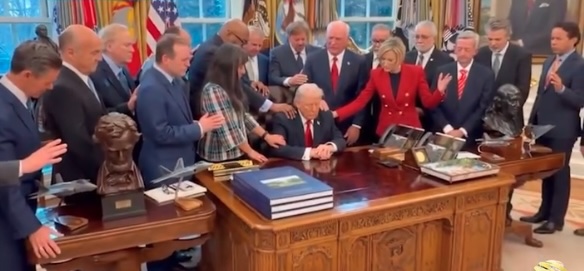
(The photo shows Trump being prayed over in the White House yesterday by a group of evangelical pastors.)
Today is Day 7 of this mass-murdering, mass-destruction project that Pres. Donald Trump named “Operation Epic Fury” (OEF). Already, the dimensions of many of its (quite foreseeable, and by many people clearly foreseen) consequences are becoming evident.
Most crucially, as of today, these:
- The Iranians’ governance and command structure has survived, despite “decapitation” strikes since its first hours that killed Supreme Leader Khamene’i and dozens of top commanders.
- Iranian forces continue, in response to OEF, to undertake stand-off attacks that seem well aimed and well coordinated and have in many cases inflicted real damage on their intended (military and economic) targets.
- Israel has exploited this situation of war, impunity, and lawlessness to (a) reimpose its super-tight siege on the two million people of Gaza, (b) sharply escalate its bombings of Lebanon and peremptorily order the ethnic cleansing of South Lebanon as well as Beirut’s densely populated southern suburbs, and (c) continue to oppress and dispossess Indigenous inhabitants of both the West Bank and Syria.
- The Iranians’ response to OEF has included attacks not just on Israeli and U.S. military bases across West Asia but also on key economic facilities in Arab Gulf countries.
- Through those latter attacks and by closing the Straits of Hormuz to shipping from OEF-associated countries, Tehran has delivered a huge blow to the global economy and especially to the Gulf Arab states that have been major bankrollers of Trumpian projects worldwide.
There are still, as of now, no signs of any imminent collapse of Iran’s command/governance structure. And meanwhile, all around the world a chorus of questions is growing louder around two key issues, either of which could rapidly increase the pressure on Washington to end the war. The first such pressure-point is the durability of U.S. stockpiles of key missile-defense and air-defense munitions needed to fend off Iran’s continuing volleys of low-cost drones and high-altitude missiles. The second is the degree, speed and temporal extent of the damage that the war inflicts on the global economy– a process that has already started.
On the matter of the munitions stockpiles, in the conversation I conducted with veteran strategic-affairs expert Amb. Chas Freeman on March 4, he estimated that existing in-theater U.S. stockpiles could still last “about ten days.” And there have been numerous news reports from generally reliable sources that the Pentagon is scrambling to pick up interceptors from several other parts of the world.
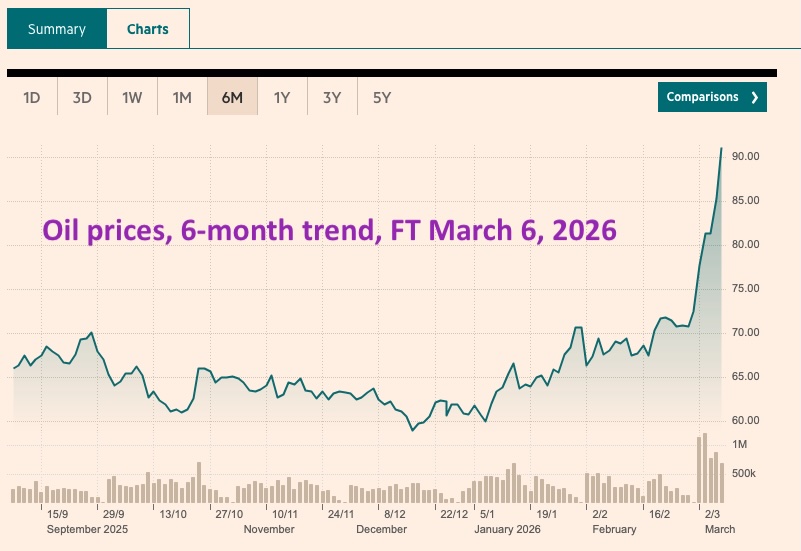
Regarding the economic consequences, we know that oil prices have now topped $92/barrel, up from $60 in early January, and they’re definitely heading yet higher. This, and the steep increase in LNG prices worldwide due to the shut-off of Qatar’s supply, will both ricochet speedily around the world economy but will hurt some countries particularly hard. Those impacted the most gravely will be:
- The Arab Gulf countries themselves (and also the Iranians.) But Iran’s economy was anyway in freefall from Trumps’scruel tightening of the sanctions a year ago. And the Arab Gulf countries’ citizens have deep reserves to sustain them. It is that huge population of non-citizen contract workers whose home countries will suffer the most from the collapse of the GCC countries’ economies. Mainly India and Pakistan, but many other countries, too.
- European countries already squeezed by the U.S.-led cut-off of cheap Russian LNG.
- India, and to a lesser extent China.
Worth noting: any increase in hydrocarbons prices is great news for shareholders of the many U.S. gas and oil companies that have already benefited hugely from Trump’s policies. Also: the U.S. is now, unlike in 1973, a big net exporter of hydrocarbons.
However, the increase in gas (petroleum) prices will hit America’s heavily car-dependent families very hard indeed. And that price increase and other disruptions from Iran’s closure of Hormuz will soon ricochet through all other parts of the U.S. economy, too. Not great news for a Republican Party led by a guy who used to swear to voters that he would end price inflation “from Day One.”
These are the circumstances in which China is, in a fairly low-key, measured way, launching a push to mediate an end to the war. On March 4, Foreign Minister Wang Yi reportedly told his Saudi and UAE counterparts that China will send a special envoy to the Middle East for mediation.
China appreciates Saudi Arabia’s restraint and insistence on resolving differences through peaceful means, Wang was quoted as saying in a phone call with the Saudi minister…
In a separate phone call with the foreign minister of the United Arab Emirates, Wang said the “red line” of protecting civilians in conflicts must not be crossed, and that non-military targets, including those involving energy, should not be attacked. He also called for protecting the safety of shipping routes.
Yesterday, Reuters reported this:
China is in talks with Iran to allow crude oil and Qatari liquefied natural gas vessels safe passage through the Strait of Hormuz as the U.S.-Israeli war on Tehran intensifies, three diplomatic sources told Reuters…
China, which has friendly relations with Iran and relies heavily on Middle Eastern supplies, is unhappy about the Islamic Republic’s move to paralyse shipping through the Strait and is pressing Tehran to allow safe passage for the vessels, according to the sources.
The world’s second-largest economy gets about 45% of its oil from the Strait.*
Ship tracking data showed a vessel called the Iron Maiden passed through the Strait overnight after changing its signalling to ‘China-owner,’ but far more sailings will be needed to calm global markets…
Iran’s government said earlier in the week that no vessels belonging to the United States, Israel, European countries or their allies would be allowed to pass through the Strait of Hormuz, but the statement made no mention of China.
(* Worth noting there, that oil accounts for only around 20% of China’s primary energy consumption– far less than for most other big economies.)
China now finds itself in a complex situation in the Gulf, and in West Asia more broadly. Back in March 2023, Wang Yi had presided over a breakthrough diplomatic victory when he organized a reconciliation between Saudi Arabia and Iran that seemingly no-one in the “West” even saw coming. That reconciliation was an important step in the (always tentative) moves the Saudis have made in recent years to distance themselves somewhat from slavish adherence to Washington’s agenda in West Asia and the world.
As the above reports from the UK-based (and to some degree London-aligned) agency Reuters make clear, Beijing is positioning itself today as a mediator between Tehran and the Arab Gulf states. It is in a good position to do so. It has important economic and financial interests with both the Arab states of the Gulf and with Iran. It is also, at the level of military tech, the supplier of some of the comms systems and guidance systems on which Tehran’s missile force and other systems are deeply reliant– as I wrote about here, last June.
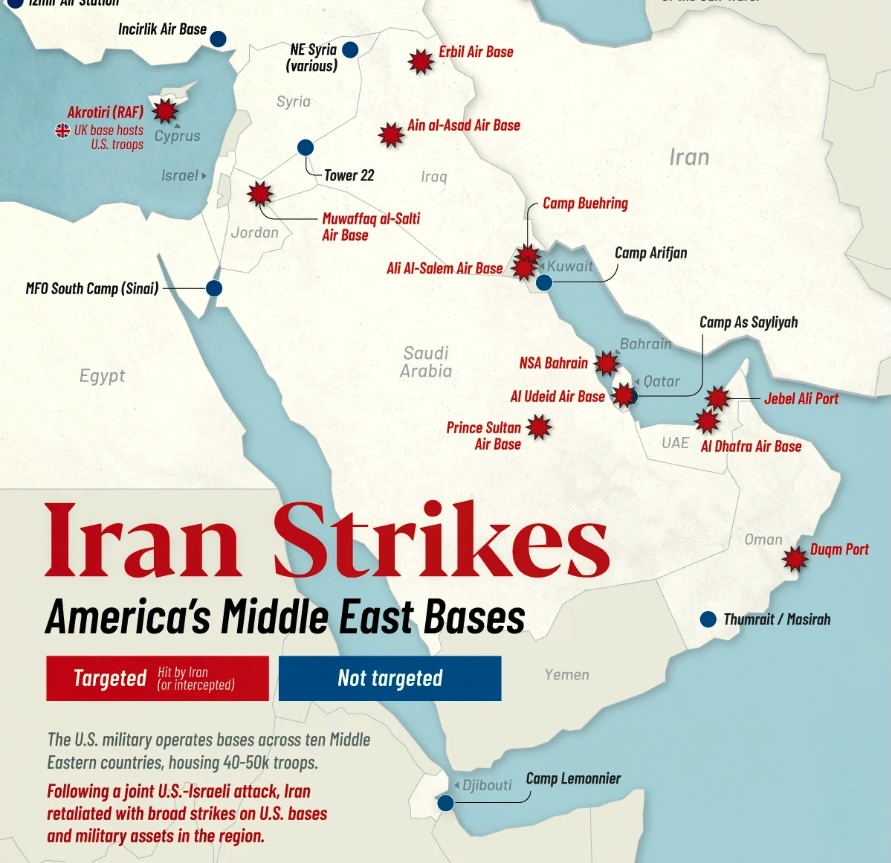
For their parts, the Arab states of the Gulf– of which Saudi Arabia is by far the largest– have all, until now, had very close military ties with Washington. Those have included both their hosting of numerous military bases and their purchase, for their own militaries, of large amounts of highly over-priced American military hardware (whose purchase has in many cases helped to keep legacy military-manufacturing plants across the United States to some degree solvent.)
The Gulf monarchies/princedoms have all maintained those military ties with the U.S. in the clear expectation that Washington would provide effective defense to all their vital national infrastructure should the need arise. The strikes that Iran launched against those states’ own infrastructure (as opposed to the ones they undertook against the U.S. bases there) were clearly designed to demonstrate to those kings and princes that hosting U.S. bases provided zero guarantee of U.S. help in defending the national infrastructure.
Indeed, on the contrary, in the present war the presence of those bases increased the likelihood of sharp and damaging Iranian attacks.
(Also: recall that last September, when Israel used drones to attack a villa in the downtown area of Doha, Qatar in which many Hamas leaders were scheduled to be meeting, the fact that Qatar hosts the largest U.S. base in the Gulf provided zero deterrent to the Israelis against launching that attack.)
I can see a potential off-ramp from the present war in which skillful diplomacy by China and other actors might achieve the following:
- The establishment of the Persian/Arabian Gulf as an internationally recognized Zone of Peace in which there would be no hosting of military bases run by non-Gulf powers,
- The charter of this Zone of Peace would be granted directly by the UN Security Council,
- In this Zone of Peace all the littoral states would work together to address any remaining military or security concerns and to build robust institutions to support cooperative efforts across a range of activities.
One model here could be the Organization for Security and Cooperation in Europe, the OSCE, which was inaugurated during the Helsinki Process in 1975 and which helped over time to assure the peaceable ramping down of the U.S.-Soviet Cold War. Let’s call it the OSCG?
Achieving such a worthwhile diplomatic goal would require a very significant retreat of American power from the region. That is not something that the adrenaline-fueled Trump or Pete Hegseth would be ready for immediately.
But surely it is a goal that opponents of war in the United States and around the world can and should aim for?
Surely, the world cannot forever live in a situation in which one coast of a waterway that is so vital to the whole world economy should be dotted with massive military bases belonging to a very distant government?
I recognize, of course, that achieving a set of cooperative structures that allow all the states of the Arabian/Persian Gulf to live together and thrive in harmony would do nothing on its own to end the horrendous and cruel rampages that Israel– with until now the full backing of Washington– continues to undertake all across Gaza, the rest of Palestine, Lebanon, and Southern Syria.
So we will also need a robust parallel project from the forward-looking diplomats of the world to end those rampages and to rebuild the lives of all the individuals, communities, and entire nations that have been so cruelly ravaged by Israel.
Like the concept of a de-militarized Gulf, this is also a goal that seems much more conceivable today than it would have, a week ago.
Remember what Trump’s hideous plan for Gaza has long been, and still is: Basically, a dystopian series of Strategic Hamlets in Eastern Gaza into which the residents of Gaza would be herded while Trump, his family, and his broligarch buddies build luxury (Dubai-style!) tourist developments along Gaza’s coast and run sweatshops for the Strategic Hamlets people all along the Armistice Line with Israel… And all of that– in Trump’s thinking– would be generously funded by his and his family’s other good buddies down there in Dubai and Saudi Arabia.
So here are some related outcomes from the Israeli-U.S. war on Iran thus far:
- The Saudis and the Emiratis won’t have spare change to underwrite any of this super-harmful “Board of Peace” nonsense, and
- The Americans and Israelis have totally lost any remaining shreds of the “soft power” they once enjoyed in the world; and if the Iranians can continue their well-prepared resistance for just 7 – 10 more days, then the Israeli and U.S. warmongers will have lost all the terrorizing effect of their military hard power, too.
… At that point, not just the Israeli-U.S. project in the Gulf will be seen to have failed, but also the whole of the Israeli-U.S. project across West Asia, including the Levant.
The “Board of Peace”? Toast.
The “Abraham Accords”? Toast.
The plans that Netanyahu, Huckabee, and Trump have been pursuing for not just a “Greater Israel” but actually a “Very Much Greater Israel” stretching from the Nile to the Euphrates? Toast.
Then, amid those ruins of the hideous outcomes sought by Netanyahu and Trump, what will we be left with? Perhaps something that would look like a reimagined and much more effective United Nations 2.0? A world body that, building on the often hollowed-out carcass that UN 1.0 has become, could at last dedicate itself anew to (an updated version of) the principles of the 1945 UN Charter.
How do we get there? We could think of using the Uniting for Peace mechanism– which was invented, remember, by Pres. Eisenhower in late 1956 when in the face of the U.K.-French-Israeli assault on Egypt he needed to find a way to circumvent the British and French vetoes in the Security Council.
As I know from my childhood back in 1950s and 1960s Britain, the breakup of empires is seldom a clean or easy matter. It often involves violence. But so, too, does the maintenance of empires, and that is what needs to happen to the U.S.-Israeli empire in the Gulf and the rest of West Asia.
It would be apt, anyway, if this process should be spurred by a significant world event involving the Strait of Hormuz. For it was in Hormuz/Ormuz, back in 1507 CE, that a significant event happened that inaugurated the whole of the 500-plus-year period in which a tiny handful of West European-origined states managed to dominate the whole world system.

The “pioneer” in that process, from 1415 CE onwards, was Portugal. In 1506 Portugal’s King Manuel sent the (by all accounts, extremely cruel) naval commander Afonso de Albuquerque on a mission to take the previously proven route around the southern tip of Africa and up East Africa to the south coast of the Arabian Peninsula. Afonso’s orders from Manuel were to “make treaties with” the cities that lined the peninsula’s southern coast and to “learn about” Hormuz, which had long had a broad reputation as a fine trading center.
By 1507 Albuquerque had reached the peninsula. The historian Roger Crowley tells us in his book, Conquerors: How Portugal Forged the First Global Empire what happened next:
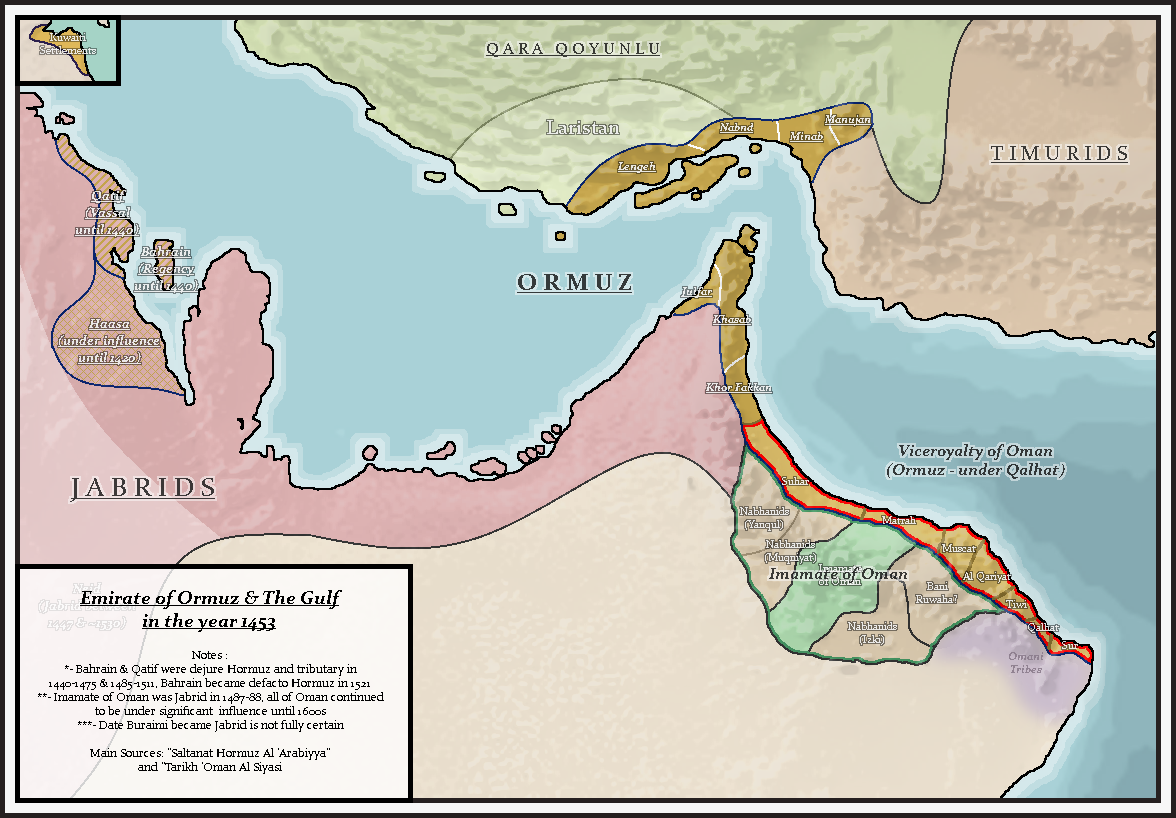
Some of the ports along the Omani coast submitted meekly. Others resisted and were sacked. Swarms of criminalized seamen from the Lisbon jails looted, murdered, and burned. Exemplary terror was a weapon of war, intended to soften up resistance farther down the coast. In this fashion, a strong of small ports went up in flames. In each one the mosque would be routinely destroyed; the destruction of Muscat, the trading hub of the coast… was particularly savage…
By late September, he reached Hormuz where, contrary to the custom of the area, he refused all gifts from the messengers of the local king and simply demanded that the king become a vassal of the Portuguese crown “or see your city destoryed.” Crowley tells us that the chief vizier in Hormuz concluded that Albuquerque, who had just six ships with him, was “severely deluded.” But Albuquerque’s ships had serious firepower, and their cannons quickly outgunned the far larger local Muslim fleet. The vizier sued for peace and agreed to payment of a “hefty annual tribute” to Manuel.
Crowley writes that “Albuquerque saw the hand of the Christian God at work in the victory.” He notes that the conqueror wrote back to Manuel gloatingly that, “A considerable number of dead Muslims, more than nine hundred, floated on the water, and most of them had many arrows sticking in their bodies… “
So there you have it. Hormuz, a fulcrum of history once again today?
