

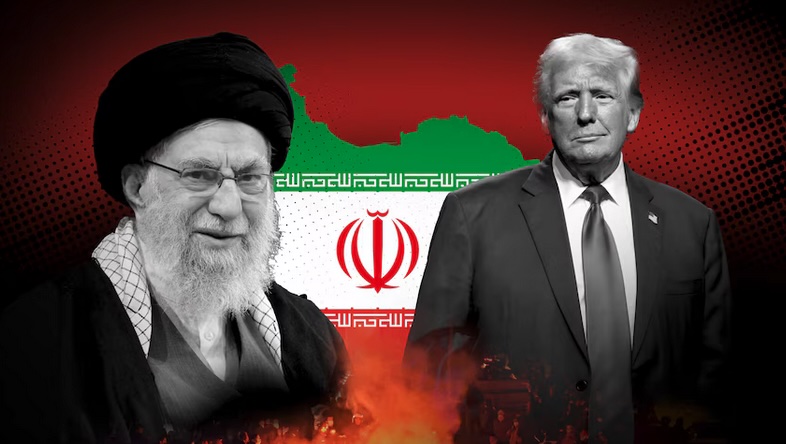
There was Trump, on Tuesday, shouting all over the internet, “Iranian Patriots, KEEP PROTESTING – TAKE OVER YOUR INSTITUTIONS!!! … HELP IS ON ITS WAY. MIGA!!! PRESIDENT DONALD J. TRUMP.” And there was Trump just a day later saying, “We’ve been told that the killing in Iran is stopping — it’s stopped — it’s stopping… And there’s no plan for executions, or an execution, or execution — so I’ve been told that on good authority.”
He was racing backward from the incendiary regime-change rhetoric of the previous day.
This was– for now, anyway– a clear case of “TACO, Iran-style”, to borrow the FT’s great acronym for “Trump Always Chickens Out.” Read on to see where I think this leaves us all now. But first, a bit of essential background.
Back in late June, in the aftermath of the “12-day War” that the U.S.-Israeli axis launched jointly against Iran June 13, I made a number of judgments, and shared some of them here and here. In the first of those essays, I judged that the reason that war ended so (relatively) swiftly and cleanly was that by June 24-25 both Israel and Iran found themselves locked in a “mutually hurting stalemate.” It was most certainly not any kind of “cakewalk” for the U.S.-Israel axis, and it certainly did not result in the unassailable U.S. win that Pres. Trump hurried to present it as.

At that time, Pres. Trump crowed very loudly that it was his employment of 14 bunker-buster bombs on B-2s to bomb Iran’s dug-deep nuclear-research hubs that had forced the Iranians to halt their attacks against Israel. (Which had been continuing throughout the whole war till then.) But Trump’s vainglorious account provided zero explanation for the reciprocal and just about simultaneous decision the Israelis took, to also halt the attacks they had been mounting against Iran.
By about June 21-22, the Israelis were also hurting badly. Haaretz was showing on June 23, ten days into war, that 31 of Iran’s significantly sized missiles had already managed to evade Israel’s missile defenses… And it was clear then, and became ever clearer thereafter, that some of those missiles had delivered hard blows to significant Israeli military, command-and-control, and nuclear-science facilities.
In that situation of mutually hurting stalemate that the two regional parties found themselves in at the end of the war, many analysts in the “West”– especially those chronically brainwashed by Israel’s longstanding boasts about the massive “edge” its military enjoyed over all possible opponents in the region– were reluctant to recognize that fact of a stalemate. “Israel will try again soon!” they warned. Some even predicted that Israel would launch its next attack against Iran “before the end of the year.”
I disagreed with that judgment, for two main reasons. One was that after Israel initiated that war– which it did with a devastating, “smart” attack that killed probably more than 40 top people between senior commanders in the Iranian Revolutionary Guard Corps (IRGC) and senior Iranian scientists– I judged that Israel had really “shot its wad” in terms of exploiting intel it had about the identities and precise locations of those key Iranian figures that had likely taken several years to build up. But the IRGC and the other wings of the Iranian military were able to keep functioning, and to keep launching those very damaging missile attacks against Israeli nerve centers.
As I’d noted in my first essay in June, the Iranian defense establishment has a lot of redundancy and resilience built in, as we had seen during that war. And the deep and highly personalized target-bank that the Israelis exploited to such great effect on June 13 could not be re-created again in just a matter of months– if ever.
Moreover, it was clear to me then, and it is even clearer now, that the Iranians would not, after that near-decapitation strike of June 13, merely be re-building the same system of defenses that they had on that day– whether for the leading personnel within their system, or for their military and research establishments more broadly. Instead, the Iranians would be learning from what had happened on June 13 and in the twelve days after that, and making the adjustments they considered appropriate. (Of course, the Israelis have been doing that, too. But my present focus here is on the Iranians.)
In the second of the pieces I wrote back in June, I noted two things:
- Much of the terminal guidance that had made Iran’s most advanced missiles, and some of its drones, so effective in reaching precise targets inside Israel, was provided by systems using China’s BeiDou navigation system. And unlike systems reliant on the Western “GPS system”, BeiDou is not vulnerable to US/Israeli hacking or spoofing.
- I also surmised that much of the vulnerability that leading Iranian personnel had had to those Israeli attacks of June 13 had been enabled by their– or their bodyguards’– use of GPS-reliant comms systems. And that from that point on, most Iranian officials would be speedily switching away from GPS reliance onto alternative, most likely BeiDou-based systems. (I have seen a few indications that that has happened.)
Thus, at the military and strategic command-and-control levels, one effect of the June 2025 war was that the Iranian leaders were strengthening their resilience even deeper than it was on June 13. Hence, because of both the Israeli wad-shooting phenomenon and the Iranian leaders’ learning phenomenon, I judged it very unlikely that the Israelis would launch another follow-up attack on Iran before the end of 2025.
Well, I called that one just about right. But it seems that a lot of people in the CIA-Mossad constellation of “Color Revolution” regime-changers who operate somewhat independently of U.S. and Israeli military planners didn’t get the memo.
At the end of December, the Iranian rial– which has been under horrendous and growing pressure from U.S. sanctions for many decades– entered a period of catastrophic collapse. On December 28, some protests started to break out against the out-of-control inflation and economic collapse this presaged. The following day, December 29, large groups of merchants in Tehran and many other cities shut their shops in protest and started to join the protesters. (CNN and many other Western media recalled gleefully that, “Merchants at [Tehran’s Grand Bazaar] played a crucial role in the 1979 Islamic Revolution that ousted the monarchy and brought Islamists to power.” Many anti-Tehran commentators predicted that the Islamic Republic could similarly be about to fall.)
At that point, the serried hordes of CIA/NED/Mossad-backed “Color Revolutionaries” mobilized for action against the Iranian government. Two major prongs of their plan seemed to be:
- To activate the coordinated use by anti-government activists inside Iran of the thousands of terminals for the satellite-based “Starlink” internet system that had been smuggled into the country by then, and
- To organize the incursion into western Iran of armed Kurdish units belonging to strongly US/Israel-dependent militias.
Regarding the Starlink deployment, some sources, e.g. the NYT, have estimated that by late December outside agitators had already sent 50,000 of the system’s (iPad-size or larger) terminals into Iran. Then, in the first few days of the protests, activists around the country used these both to coordinate with each other and to send to the outside world images of many of their protest actions– and of the effects of the police response, including some photos showing rows of body bags.
(Some of those images did not reflect very well on the anti-government forces. There were video clips of shadowy people– apparently protesters, though possibly in some cases police units– using flamethrowers and Molotov cocktails to cause large and mid-size fires, including apparently in mosques and husseiniyehs. Many such images could not be authenticated. Some were. Others were judged by specialists to be AI fabrications. But the over-all impression was most decidedly not one of disciplined Gandhian protesters bravely confronting the government’s well-armed forces…)
And meantime, as Reuters and others have reported, armed fighters from one or more ethnic-Kurdish groups were crossing into Iran from the semi-autonomous “Kurdish region” of northern Iraq, where they exist with the more or less overt support of U.S. and Israeli operatives who are active there. The Kurdish population straddles northwest Iran, northern Iraq, north-eastern Syria, and vast swathes of eastern Turkey, and Turkey’s central government has been in an intermittent state of war against many of its Kurdish citizens for several decades. According to the Reuters report it was Turkey’s powerful military intelligence that informed the Iranian authorities of the Kurdish incursions; and in early January the IRGC sent units to the Luristan region to suppress them.
Meantime, other pro-government units in Iran were acting to disable the Starlink comms system. On January 8, as the Iranian authorities switched off the regular, ground-based internet systems for most users, IRGC units also started sending out (apparently Russian-developed) mobile units to jam the GPS signals that Starlink users were using to communicate with Elon Musk’s broad fleet of low-orbit satellites. As Defense Security Asia reported, this marked,
the first successful state-level neutralisation of low-Earth-orbit satellite internet, reshaping the global balance between digital freedom, satellite sovereignty, and electromagnetic power.
Throughout the first ten days of January, it became clear to increasing numbers of pro-regime-change actors in the West that any hopes they’d had in the last days of 2025 that this time they could finally achieve their long-held goal of overthrowing the Islamic Republic of Iran would once again be frustrated.
The two preceding occasions on which those hopes had been raised were during periods of significant anti-IRI popular agitation in 2019, and then again in 2022. On both those earlier occasions, the insurgent forces had been beaten back, and the government survived. And for now, it looks as if the IRI remain in the power for some time to come. What are the longer-term prospects?
I do not pretend to be an expert on the internal politics of Iran. I have only worked there once, briefly, as a journalist– and that was on a reporting trip I made there in, I believe, early 1978, in the days of the Shah and his ghastly Savak torturers. (For information on internal Iranian developments I follow a range of long-time experts including Trita Parsi, Ellie Geranmayeh, Mohammad Marandi, Sina Toossi, etc…)
What I do try to follow more closely is the role that Iran plays in regional and global politics, which is, obviously, not at all a trivial one. Back in the days of the Shah, he was a buttress of U.S. and Israeli power in a broad region encompassing not just the Arabian Peninsula and the Levant but also much of Central Asia, too. His toppling in 1979 by the savvy organizing networks of Shiite Muslim thinkers and institutions that brought Ayatollah Khomeini to power had very broad regional and international implications. And ever since then, the power centers in Washington and Tel Aviv have worked super-hard to overthrow the Islamic Republic, or if that should be impossible at least to tightly curtail its power. They have used a mixture of means to do this:
- Military attacks– including, most notably, the support that Washington gave to Iraq’s Saddam Hussein for the brutal war that he waged against Iran from 1980 through 1988, but going right through to the attacks Israel launched against Iran and Iranian/IRGC commanders in April, July, and October of 2024, and then the 12-Day War of last June;
- Assassinations, sabotage operations, and cyber warfare, undertaken mainly but not exclusively against people and facilities involved in Iran’s nuclear-research projects;
- Extremely coercive economic measures (sanctions), and some closely linked coercive diplomacy; and
- Campaigns of political subversion on the “Color Revolutions” model that Washington has used elsewhere: in West Asia, in countries bordering Russia, and in several Latin American countries.
This is sometimes an unwieldy tool-box to use effectively. In many of the countries that have suffered deep and evident harm from Washington’s sanctions, it is hard for the United States to present itself as the population’s “savior”. Many leaders of potential “Color Revolutions”– but not Venezuela’s María Corinna Machado!– have worked hard to hide the degree to which they’ve been getting material and military support from the United States. In Syria, for example, the CIA went to some lengths to obscure its involvement in Operation Timber Sycamore, a five-year-long project to funnel arms to the various (often Qaeda-linked) rebel formations fighting to topple former Pres. Asad.
Thus, on January 13, when Trump issued his vociferous, all-caps call to Iran’s rebels to “TAKE OVER YOUR INSTITUTIONS!!!” and assured them that “HELP IS ON ITS WAY”, that call probably felt to many of the anti-IRI activists inside and outside Iran like a deep stab in the back. (It was hard, as always with Donald Trump, to understand what was going through his head at that time. Of course, there was a deeply performative aspect to his call. As matters transpired, that call also set him up to be able, the following day, to claim a “win” when he announced that– due to his own outstanding efforts!– the Tehran government had been forced to “back down” and cancel the executions they had earlier planned for January 14. No evidence was ever offered for those claims.)
Meantime, however, the military/cyber dimensions of the balance between the IRI on one hand and the U.S.-Israeli Axis on the other had not changed very much since the end of last June. Indeed, perhaps the balance had shifted some in Iran’s favor. For two reasons:
First: Back in June, the U.S. Navy still had two heavily armed carrier battle groups sailing around not far from Iran’s territorial waters. For the past few weeks, after one carrier battle group and numerous other naval assets were sent to the Caribbean, it has had zero in or near the Persian Gulf.
Second: Given that the situation as of the end of June was essentially a stand-off, a mutually hurting stalemate, we can surmise that in the six months since then both the main front-line parties, Iran and Israel, have been working hard to strengthen their military positions, fix any weaknesses revealed during the June War, and so on. For Iran, that effort has been the central and over-riding focus of the entire national-security leadership. The ability they’ve shown to stymie the utility of even tens of thousands of Starlink terminals is just one sign of their success. (These terminals, remember, potentially have great military utility, as shown in Ukraine, as well as utility in mobilizing popular protests.)
In Israel, meanwhile, the national-security bosses have had to address several other challenges, as well, in addition to preparing for the “next” war/altercation against Iran. They have had to deal with continuing their pursuit of the genocide in Gaza, continuing their offensive operations against Lebanon and Syria, and continuing to back the large settlement-expansion projects in the West Bank. Those tasks have absorbed not just significant continuing amounts of war materiél but also, importantly, considerable proportions of the attention of the country’s military and intel establishments. (And Israel is a pretty small country. Its capacities have been badly over-stretched for the past 27 months.)
Small wonder that, as The Washington Post reported January 14, “Days before protests erupted in Iran in late December, Israeli officials notified the Iranian leadership via Russia that they would not launch strikes against Iran if Israel were not attacked first.”
Was the timing of that message purely coincidental, or did the Israelis already know that big protests were due to erupt inside Iran just “days” later? I don’t know, but it’s an interesting question. The WaPo piece also implied that the late-December messaging between Israel and Iran was not the first instance of Russian-mediated communication between them.
The WaPo account tells us two other interesting things. First, that the Iranians had responded positively to that late-December Israeli message, through the same Russian channel, saying they also had no intention of being the first to strike Israel. And second that, according to (unidentified )diplomats and regional officials, “the contacts reflected Israel’s desire to avoid being perceived as escalating tensions toward Iran… at a time when Israel was preparing a significant military campaign against [Lebanon’s] Hezbollah.”
That latter part of the message may have been an attempt to sow distrust between Iran and Hezbollah? But anyway, it did also indicate a recognition by Israeli officials that crucial aspects of their capabilities were stretched extremely thin.
So where does all this leave the 92 million people of Iran, their government, their neighbors,and their place in West Asia and the world? Here are my first quick takeaways:
- “Color Revolutions” in distant countries get a lot of– often fairly unthinking– support amongst publics in the West who have long been intensively groomed by their media to support such efforts. The idea that Baby Shah could even get a hearing in some Western countries as a “beacon of democracy” shows how unthinking or uninformed some of that support can be. But Color Revolutions mix very uneasily with any form of planning for military action by foreign powers. I send my deepest sympathies to lovers of democracy in Iran (or Venezuela, or just about anywhere) who can believe that either Baby Shah, the Israeli military, the U.S. military, Pres. Trump, or Kurdish militia gangs would actually come in and “save” the people of Iran.
- If the military stand-off between Israel and Iran continues, and if it continues to shift– as I believe is happening– in favor of Iran, that still does not solve the crisis that U.S. sanctions and Washington’s seizure of massive amounts of Venezuelan oil will continue to inflict on Iran’s economy. The scale and nature of the recent protests, and the speed with which they spread, underline the need for a speedy and effective shoring up of the economy. Are there ways to do this that will reduce or completely cut Iran’s reliance on the treacherous dollar-based system? I certainly hope so.
- The regional/global politics around this whole confrontation have been intriguing. As happened last June, we have seen the big petro-states of the GCC/Arabian Peninsular adopt– to their best of their ability– a stance of neutrality. But for Turkey, a NATO member, to have apparently taken the initiative to warn Iran about the plans of the (US-backed?) Kurdish infiltration squads was certainly notable. Also intriguing: Russia’s role as a bearer of messages between Israel and Iran. I am pretty sure that other states– especially Oman– are also ready to play this role. The greater the number of trusted intermediaries there are, the better!
- The UN has once again been completely on the sidelines.
Addendum, January 17, 2026:
Azadeh Moaveni has a very informative piece in today’s FT in which she underlines the degree to which all the recent eruptions of protest in Iran, including the “Woman Life, Freedom” protest of 2022, were sparked to a very large degree by (sanctions-fueled) economic privation. She also notes the horrendous impact that the draconian further tightening of the sanctions that Trump imposed in March 2025 had on low-income families across the country. Excellent points to bear in mind. Thanks, Azadeh!

Good paper. Will the Saudis persuade/bribe Trump not to attack Iran once the US aircraft carrier groups are reassembled and Israeli missile defense beefed up?
Another wild card is how far Iran (indeed anyone) can trust what Israel or the US says, either through back channels or directly. There is a history of planned deception when peaceful overtures are quickly followed by kinetic attacks. This makes planning for those on the receiving end difficult for obvious reasons.