

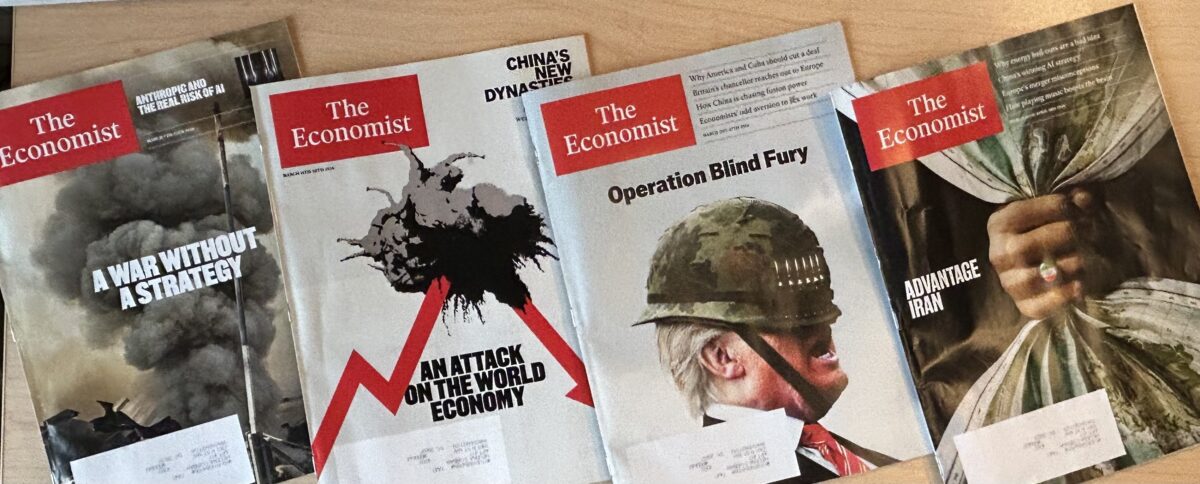
The reality of the defeat of the Israeli-U.S. Axis in the outrageous war of aggression they launched against Iran (and Lebanon) on February 28 is starting to sink in for significant portions of the political elite in “Western” countries.
Above, see the cover art produced by the influential U.K. news magazine The Economist on March 7, 14, 21, and 28 (left to right.) Even prior to the launching of the war, in the issue it distributed February 27 (dated February 28), the mag warned in an editorial that “Starting a war with Iran without a clear objective would be recklessly dangerous.”
In the issue that dropped today, the cover art was unambiguous: “Advantage Iran.” And the wording of its editorial was stern:
Mr Trump must agree to a full ceasefire, and compel Israel to abide by it… Any eventual deal will be worse than what could have been struck before the war began, because Mr Trump has unwittingly strengthened the hand of hardliners and made clear the leverage they have over the strait [of Hormuz.] The result is that for now, at least, the advantage lies with Iran.
I am far from being someone who agrees with all the policy prescriptions peddled by free-marketeer publications like The Economist, the Financial Times, or the Wall Street Journal. But I’ll say this for the first two of these outlets: because they consider that a good part of their mission is to provide information to big shots in the financial markets that is accurate, timely, and non-ideological, a lot of their reporting and their commentary is both on the mark and pretty thought-provoking.
So, after just the first days of this present war, world commodities markets were distraught. And it wasn’t just the oil and gas markets. Numerous significant producers of agricultural goods worldwide have been very reliant on fertilizer products shipped out of the Khalij/Gulf:
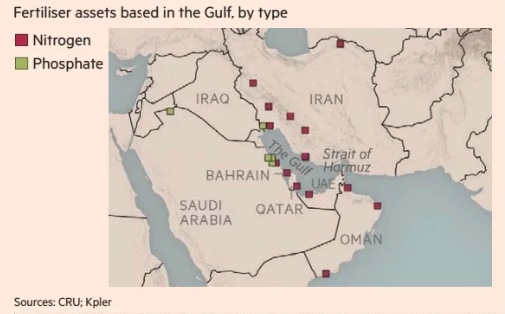
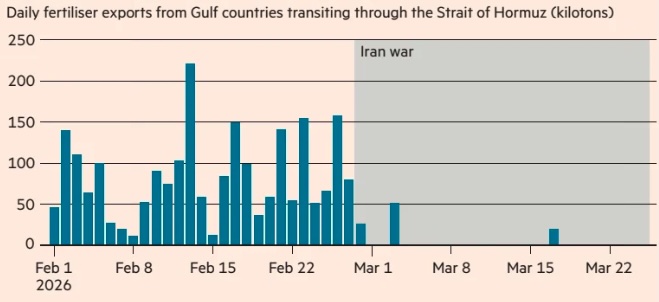
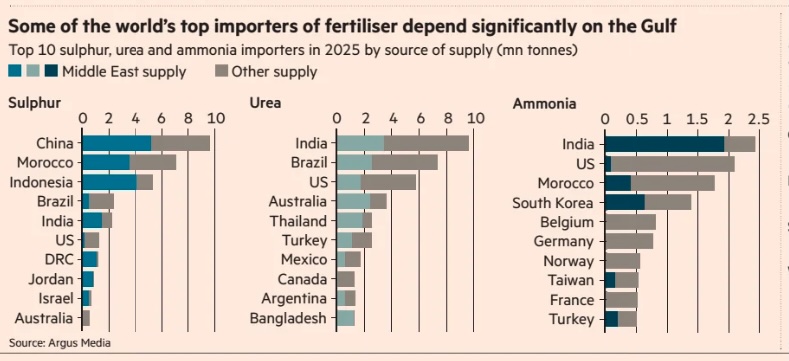
Those images were in the FT on Wednesday. Click on any of them to expand it. The third one shows the dependence of various countries on fertilizer products shipped from the Gulf. India and China are both right up there. But of course, increased production prices in any national markets ripple speedily throughout the whole of today’s heavily globalized economy…
Writers in (basically investment-advising) outlets like The Economist or the FT have expressed dismay at many different aspects of the current Israeli-U.S. war against Iran:
- The war launchers’ very evident lack of planning for it.
- The fact that its launching was in clear violation of (and therefore a deep challenge to) the most basic rules of an international order in which nearly all the “captains of industry and commerce” who are their prime readers have thrived very nicely indeed.
- The fact that the Islamic Republic of Iran, which is not part of the “Western” world order, has proven itself so resilient and so smart that it could not only withstand the U.S.-Israeli assault but also– as even The Economist acknowledges– emerge in a situation of clear advantage over its assailants.
- The fact that, in his crazy-mouthed “leadership” of this war Pres. Trump has revealed himself to be quite untethered from any relationship to facts, evidence, or coherence. And this is the man who’s the leader of the “Western” order of which these publications are such strong defenders? (Plus, of course, he and his close conspirator PM Netanyahu both potentially have their fingers on their respective nuclear buttons…Truly terrifying.)
Small wonder that after assessing the situation, on Wednesday the FT’s Ed Luce concluded:
What remains to be seen is how Trump will find a way out of this morass. He wanted to bring down Iran’s regime. Now he is lifting sanctions on Iran so that it can sell more oil. Amid the torrent of feints, hype, invention and bluster, Trump’s goal is now to set the clock back. With planning like this, who needs chaos?
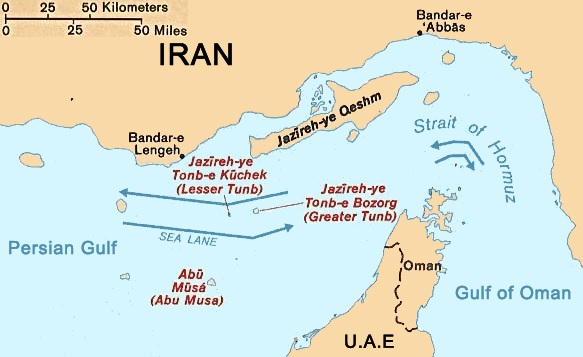
There is, I know, a lot of concern about the possibility of a U.S. assault on Iran’s terrain through the use of either paratroops or amphibious forces. While most western commentary focused on Kharg Island, Elijah Magnier was recently writing about the possibility of a U.S. landing on one of the three islands, Greater and Lesser Tunb, and Abu Musa, that lie in the Khalij close to Iran and have been controlled by it since the Shah’s days– though they’ve also long been claimed by two of the smaller members of the United Arab Emirates…
My judgment on the possibility of the U.S. military actually landing troops on this or any other Iranian-controlled territory is that: (a) Trump must surely know that landing American boots on such distant ground would almost certainly kill any hope for his party to minimize their losses in the upcoming midterm elections; and (b) Even if the Pentagon could organize a symbolic landing of U.S. troops somewhere on Iranian-held soil, with a low level of casualties– a big If!– Trump would still not have done anything significant to erode the “advantage” that Iran currently holds in this war.
It is clearly now time– as even The Economist is urging– to look for off-ramps. I have made a couple of suggestions of my own in recent weeks, e.g. here. But now I think that, like many people suggesting the content of possible off-ramps, I have been looking at/for the wrong thing. Instead of looking at the “What” of what might constitute a workable and durable off-ramp, I think we should look first at the “Who” might lead this diplomacy:
Who– that is, what combination of forces in global society– is in a position to both intermediate/negotiate a workable off-ramp from this war and also to monitor and support it as, and after, it starts to go into implementation?
Once upon a time, this would have been an easy question to answer. The United Nations, of course! Isn’t that what the UN has always been for, over the past 80 years?
Well, it is not fit for this purpose, now, for a number of reasons. Primarily because the Security Council that sits at the apex of the UN as a whole, and most specifically the apex of any or all of its peace-making and peace-keeping operations, is today completely useless. The Security Council was unable to do anything, over the past 28 months, to bring to an end Israel’s continuing genocide in Gaza. It did nothing to punish Israel or its U.S. backers for the, deadly, illegal, and very provocative raids that the Israeli military undertook against Syria, Lebanon, Yemen, and Iran from the Spring of 2024 right through to February 28 of this year. Last November the Security Council even– to its eternal shame– adopted the outrageous and self-dealing “Board of Peace” that Trump concocted out of whole cloth as his “solution” for the devastation the U.S. and Israel had visited on Gaza. Then earlier this month, the SC even adopted a resolution that criticized Iran for the strikes it had undertaken against other states in West Asia while it made zero mention for the massive Israeli-U.S. assault on Iran that had provoked those retaliations…
So if the UN and its Security Council today seem quite incapable of fashioning an off-ramp from the present war that can put in place a situation of sufficient durability that it does not lead to a re-eruption of the fighting 8 months, or 12 months, or five years down the line– then what powers in world affairs can do that? My first shot at an answer to this question is that it would be some combination of China, the Europeans, and the Global-South allies that either (or both) of those parties can muster.
I think both China and the EU share many concerns about the current war, and they could also be said to share several goals as they try to design what an off-ramp might look like:
- These parties share a concern about their own intense vulnerability, and that of valued partners, to the gross economic disruptions occasioned by the war.
- They both– like just about all other peoples and governments around the world– want to see the Strait of Hormuz re-opened, and re-opened under a regime that is built through agreement, not force, and that promises continuing stability for the whole Khalij region and its trading and investment partners from all around the world.
- Both these parties have professed support for the rules of international order that were encoded in the UN Charter and have actively worked– to perhaps differing degrees– to see these rules effectively implemented worldwide.
- Both these parties (and their allies and partners around the world) share a continuing concern about the unstable nature of Washington’s current leadership and the deep, broader instability that this leadership has imposed on all the peoples of the world.
There remain many wrinkles and complexities in this picture. Firstly, there’s the huge variability among the positions taken toward this conflict by the 27 different members of the EU. (Between Spain, and Germany, for example.) Then, there are the differences between Beijing and Brussels on the two thorny issues of Israel, and the Ukraine War. Of those, perhaps the differences over Ukraine could be set aside for now. But how about attitudes and policies toward Israel?? Those cannot be set aside in any of the urgent diplomacy that’s now needed to find a workable off-ramp from the Iran war.
But maybe we should also ask, how deep really are the differences between Beijing and Brussels over Israel? Could the two sides not agree that settled international law should be the main arbiter in assessing support or opposition to Israel’s actions? In that regard, we have seen the landmark July 2024 ruling from the World Court that Israel’s actions in all the lands that it has seized during and since the Arab-Israeli War of 1967 are null and void; that Israeli forces and settlers therefore need to withdraw completely and speedily from those lands; and that Israel needs to pay reparations to the rightful residents of those lands.
And certainly, settled international law would judge that the unprovoked assault that Israel and the U.S. launched against Iran on February 28 was completely illegitimate…
So there is some reason to hope that either the EU as a whole, or some key European states, could find common cause with Beijing as they search for a durable off-ramp from this war. Some other quick data points in this regard:
- Both these parties enjoy good relations with the key Arab Gulf states whose active participation in any Hormuz security regime is a sine qua non for its success in both the shorter and longer terms. (And the Chinese– unlike, as far as I know, the Europeans– have a good track record of negotiating solid steps to de-escalate cross-Khalij tensions and start to build cooperative projects between the states on both of its shores.)
- China’s diplomats, for their part, have already, since Day 1 of this war, been very active in reaching out to explore possible off-ramps and confidence-building measures with governments across the region, including in all the relevant Arab countries and in Israel.
- China also has a strong working relationship with the government in Pakistan, which has recently emerged as a key intermediary through which Iran is willing to communicate its political/strategic positions to a world audience.
Today, for example, Chinese FM Wang Yi held a phone call with his Pakistani counterpart, Ishaq Dar. The readout on that call from CGTN said this:
Dar briefed Wang on the latest developments in Iran and Pakistan’s assessment, thanking Beijing for supporting Pakistan’s mediation efforts…
Pakistan and China share the same goals and positions on this issue, Dar added, and Pakistan looks forward to working with China to play an active role in promoting peace and a ceasefire.
Wang said China and Pakistan, as strategic partners, held an objective and consistent position on the conflict. He praised Pakistan’s efforts to ease tensions.
The Chinese foreign minister said launching peace talks is not easy, but only by getting them started can further casualties and losses be avoided…
China is willing to strengthen coordination with Pakistan to promote peace and stability in the region, Wang added.
Both sides agreed to push for a ceasefire, resume dialogue, ensure the safety of non-military targets and shipping lanes, and support the primary role of the United Nations.
(I found that last point interesting.)
So the consideration I give above of the “Who” of the diplomacy that’s needed rather than, at this point, the “What” (the content) of it, brings to mind– yet again– the comparison with the Suez crisis of 1956. Many people have written recently, including me, about the parallels that exist between that war/crisis and the present one. In both of them, the government of Israel worked hand-in-glove with a (fading) colonial power– or in the case of Suez in 1956, two fading colonial powers– to persuade them that through a big joint military operation they could radically shift the shape of most of West Asia in a pro-Western and pro-Israel direction…
But there are also many differences between these two cases. One very evident one was the way the Suez Crisis got resolved, namely, through the effective and speedy intervention of Pres. Eisenhower who almost from Day 1 of the illegal Tripartite Aggression against Egypt took a number of firm steps to roll that aggression back. Crucially, he stated his loud and clear opposition to that military action; and within just days he also took concrete steps to help compel the leaders of the three aggressing countries to withdraw completely and as fast as possible from Egypt. In the case of Britain’s (fairly delusional and hate-fuelled) PM Anthony Eden, Eisenhower said simply that he would pull out all the U.S. support on which the pound sterling relied, unless Eden’s government complied with Ike’s instructions that the UK withdraw its forces from Egypt, completely. So London, Paris, and eventually even Tel Aviv all pulled their forces out of Egypt, and a UN peacekeeping force was inserted into Sinai instead.
Right now, it is impossible to think which world power, or which combination of world powers, might be able to take the clear and effective leadership role that Eisenhower took in 1956. In 1956, American economic power still dominated just about all of the global economy. And though Britain and France were still significant world powers who held vetoes in the UN Security Council, they were both also still reeling from the devastating effects World War 2 had had on their national economies, and hence very vulnerable to Eisenhower’s forceful threat of economic action.
The same is not true today. There is no one clear rising hegemon today, analogous to Eisenhower’s United States. (It needs to be noted, though, that American power was not wholly unchallenged at the global level back in 1956. Washington was in a fierce contest with the rising power of the Soviet Union. And one of the reasons Eisenhower acted as decisively as he did against the Tripartite Aggressors was because he wanted the world’s outrage to stay focused on the steps Moscow and its allies were taking at that exact time against the CIA-supported rising in Hungary…)
The bottom line here is that neither China nor any other single government enjoys the same kind of power within the international system that Eisenhower’s United States did back in 1956. That makes the search for a solution– and even the search for the “Who” of a solution– much more complicated today.
On the other hand, the ripple effects from the Aggression of February 28 all around the world are far speedier and more destabilizing than any of the second-order effects of the Tripartite Aggression of 1956. Thus, the motivation to find a speedy and durable off-ramp is much, much more widely shared around the world today than was the motivation to find an off-ramp in 1956.
Which power or combination of powers can organize the globe-girdling, coalition-building diplomacy that can make this happen? That is the key question, and the answer to it will provide a helpful signpost for how global governance is likely to be organized for many more decades to come.
