

Let me first state what this Israeli-U.S. war against Iran is not about. It is not about “democracy” in Iran. It is not about Iran being anywhere near to– or even working to reach– the threshold of nuclear arms possession.
So what is it about?
For the Zionist settler colonialists of Israel’s always hyper-militarized political elite this war is quintessentially “about” the continued existence of an independent, coherent Iranian state and the ability of this state to project power across much of West Asia. To be precise, for the Israelis, the war is about destroying the Iranians’ capability to maintain any such state.
For much of the (hyper-Zionized) U.S. political elite it is also about this. But in the ruling Republican Party here, the influence of the pro-Israel crowd has been sharply contested in recent months. And even in the (chronically pro-Zionist) Democratic Party leadership circles, the pro-Israel narrative has lost considerable power, especially among the broad ranks of politically engaged, and mainly younger, people. The perennial pro-Israel narrative does retain a strong grip on most of the country’s legacy media; but the reach and influence of that media has waned sharply in recent years, especially since October of 2023.
So a very large mass in the U.S. engaged body politic no longer buys Israel’s narrative about this war. Meantime– and this is worth noting– a very large portion of the engaged body politic has important family investments in the U.S. stock market, through their (our) retirement funds. Plus, nearly everyone in the U.S. is concerned about prices at the gas pump and their knock-on effect. So if they do not buy the Zionist narrative, for most of these people, why should they support this war, especially knowing that its economic costs will certainly continue to balloon, the longer it continues?
I have a different framework for looking at this war. I do not see it as being “just” about West Asia (the region formerly known as the Middle East), or “just” about the next one or two rounds of U.S. elections. I look at it from a perspective that is both historically and geographically much broader.
This is a war that is about control over a key node in the global economy, and therefore about the global economy and global society as a whole.
This is a war, too, whose outcome can potentially have as much influence over the course of the coming centuries as did the capture back in 1507 CE of the wealthy and proud city of Hormuz by ultra-violent Portuguese marauders who were backed and funded by a strongly pro-Crusader monarch back home in Lisbon.
So no, this war is not “just” about West Asia. And it is not “just” about the next few months or years. It is about a whole lot more.
Thus far, the Islamic Republic of Iran has stood resilient and steadfast in the face of all the violent attacks the Israelis and Americans have undertaken against it since February 28. Throughout their many decades of preparation for this or a similar assault, the IRI’s leaders had built a national infrastructure that is hardy and resilient at all the key levels, including the political, the military– and also the physical.
Throughout the current war, Trump and Netanyahu have both voiced harsh threats to “destroy” or “obliterate” all of Iran’s national infrastructure. (Trump today suspended implementation of those threats for five days; but he kept them on the table.)
We’ve already seen in action the resilience of Iran’s political and military infrastructure. Regarding its physical infrastructure, on March 21, after Trump’s latest round of threats, the Canadian infrastructure specialist Michael Spyker released on X a number of maps (and associated commentary) that demonstrate the hardiness of this infrastructure:
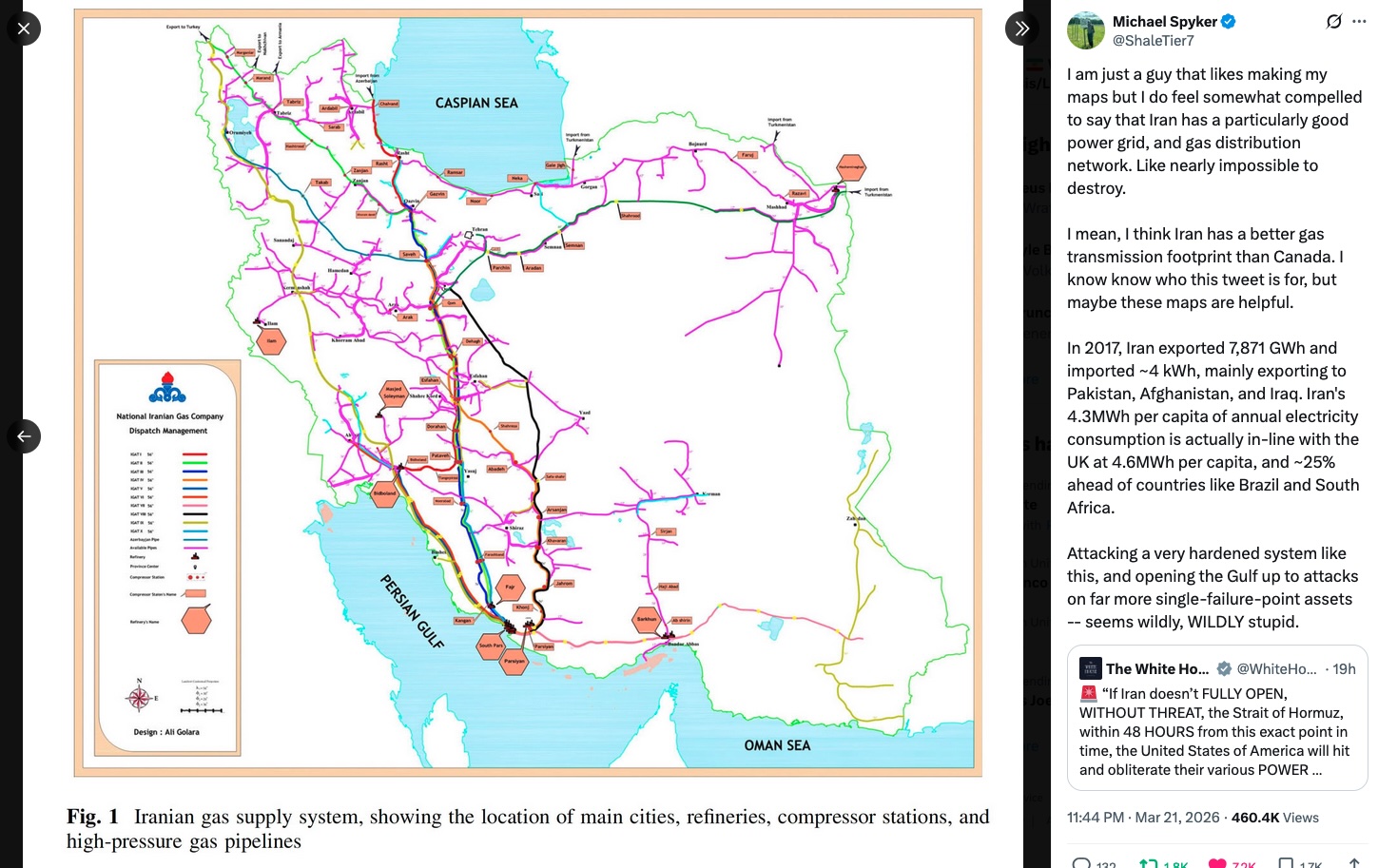
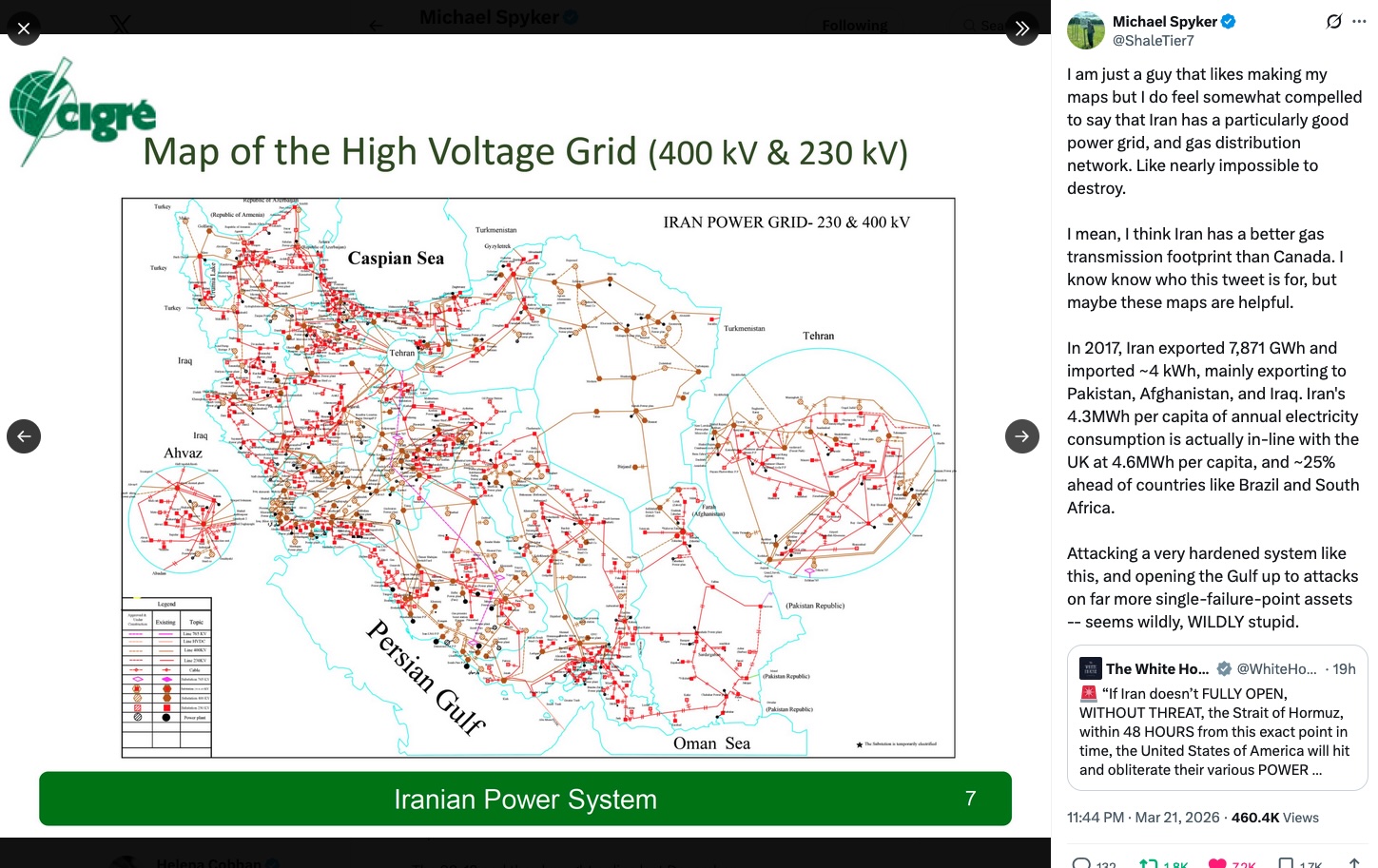
Click on either map to enlarge it. Here’s the nub of Spyker’s commentary:
I am just a guy that likes making my maps but I do feel somewhat compelled to say that Iran has a particularly good power grid, and gas distribution network. Like nearly impossible to destroy. I mean, I think Iran has a better gas transmission footprint than Canada… Attacking a very hardened system like this, and opening the Gulf up to attacks on far more single-failure-point assets — seems wildly, WILDLY stupid.
So over the past days the rulers in Tehran have had a high degree of confidence both in the survivability of their own essential infrastructure and in their ability to deliver, as needed, tough retaliatory strikes against vital targets in Israel and the other U.S.-supporting states throughout West Asia. Far from bending or submitting to the aggressive (though often inchoate) demands of Trump and the Israelis, they have refused since February 28 to engage with Trump politically at any level, and over the past two weeks they have declared their own very clear list of demands for ending the war.
As best I understand them, the IRI’s key demands at this point are as follows:
- A complete cessation of hostilities that has durable, credible monitoring mechanisms
- The exit of U.S. military bases from all of West Asia
- Sizeable reparations from the aggressing nations for the damages they caused to Iran, and
- That Washington take credible, effective steps to rein in Israel.
The second of those demands is the key to the geopolitical/geo-economic transformation of the Gulf region, and by extension to the rest of West Asia– and indeed to the entire, rich and multi-layered Indian Ocean trading system within which the Gulf and the Strait of Hormuz have for several millennia now acted as a key node.
The Gulf/Khalij region plays a key role in today’s highly connected global economy in ways that go far beyond its role as being “just” the location of 55% of the World’s oil reserves and 33% of its oil-delivery capacity. Beyond that, the sovereign wealth funds and private investors from the Arab states of the Gulf have become a significant and still-growing force in global finance; and through those international investments they have become tied into many other key aspects of today’s global economy. For example, Dubai’s “DP World” is a significant player in port ownership and logistics on many continents; and the UAE (and to a lesser extent Saudi Arabia) have become key partners in global investments in AI and the physical infrastructure needed to support it.
I noted here, recently, that for nearly a century now,the whole of the Southern coast of the Gulf has been, essentially, a playground for “Western” militaries–and so, until the Islamic revolution of 1979, was the Northern coast. I would actually go much further than that, and note that the Gulf and its littoral states were a “playground” for the London-based East India Company, and the well-armed naval and ground forces that it commanded, from the 17th century on.

Leaping through the recent centuries now, let’s note that in the 19th century, British imperial planners continued to view “Persia” mainly through the lens of the contribution it could make to defending the British Raj in India (including from potential inroads the French might make into it.) Then, in the early 20th century, a London industrialist and adventurer bought the rights to drill for oil in Persia. His company hit a valuable gusher in 1908, and thus was born the Anglo-Persian Oil Company, APOC… which later extended its operations to Iraq, as well.
In 1913, Britain’s young naval chief Winston Churchill signed a deal with APOC– later named the AIOC– that gave the Royal Navy vital access to good quantities of oil during World War 1.
Later yet, American oil interests got good access to oil fields (and political/military power) across the Gulf in Saudi Arabia, while the British maintained their naval-basing relations with the gaggle of small princedoms strung along the southern coast of the Gulf until the late 1960s. Then, after the retreat of British naval power from “East of Suez”, the U.S. Navy replaced the Brits in all the big naval bases in Kuwait, Bahrain, the UAE, and Oman. (Oh, and along the way there, in 1951, Iran’s democratically elected PM, Mohammad Mosaddegh, nationalized the AIOC. He was then overthrown two years later in a coup orchestrated by the CIA.)
The bottom line here is that from 1507 CE until 1953, the entire coastline of the Gulf, as well as its waters and islands, was an area which the navies and business interests of Western nations had free play. Mosaddagh’s bold action interrupted that domination, but it was speedily reversed. Then, the whole Gulf area again became a playground for Western imperial interests– until 1979, when the Ayatollahs toppled the U.S.-backed Shah. The Islamic Republic of Iran has remained sturdily in power ever since. it survived the blistering, Washington-supported war that Iraq’s Saddam Hussein waged against it, 1980 through 1988, as well as many much smaller attacks that Israel and the Americans have sent its way since 1988.
Was there ever a chance that relations between the IRI and Washington could have settled, somewhere along the way between 1988 and 2025, into something like an uneasy co-existence of powers with the U.S. retaining strong ties with the Arab states of the Gulf and the IRI’s rule along the Northern coast remaining uncontested? Quite possibly. During those years we saw these phenomena:
- The Iranians essentially standing aside and allowing the U.S. military to pursue its punishing, violent overthrow of Saddam Hussein in 2003. (Indeed, Iran even hosted for some weeks prior to the invasion the man whom many in the Bush administration were supporting to take over as ruler in Iraq: Ahmad Chalabi. That plan to install him, however, never came to anything. he had radically oversold to the Americans the extent of his power and influence back home…)
- In 2015, the Iranians concluding the key agreement on disposition and control of its supplies and production capacity for enriched uranium that signaled that a new era of cautious cooperation on a broader range of issues might also now be possible.
After Iran, the United States, and five other governments concluded that JCPOA in 2015, two parties became firmly determined to reverse it. They were the government of Israel and Donald Trump, a grifter long on the payroll of wealthy Israeli and pro-Israel donors who managed to win U.S. presidential elections in 2016 and again in 2024.
In 2018 Trump abruptly took the U.S. out of the JCPOA and took other significant steps from the agenda long pursued by Israel. One of those, his sponsorship of the “Abraham Accords” paved the way for the Israeli and U.S. militaries to start doing the intense planning across the whole area of West Asia that, after Trump re-entered the White House in 2025, enabled them to launch the first (June 2025) and then the second of their big assaults against Iran.
We are now (March 23) in a phase in which everyone all around the world can see the harsh consequences– for Iran, for Lebanon, for Gaza, and for people and institutions within those ultra-wealthy Arab Gulf states, and in Israel– of February 28’s unprovoked, Netanyahu-Trump assault against Iran. And because of the role that the Arab Gulf institutions play within global oil and gas markets, in worldwide supply chains, and in worldwide financial markets, the effects of this war were rapidly shown to be truly global.
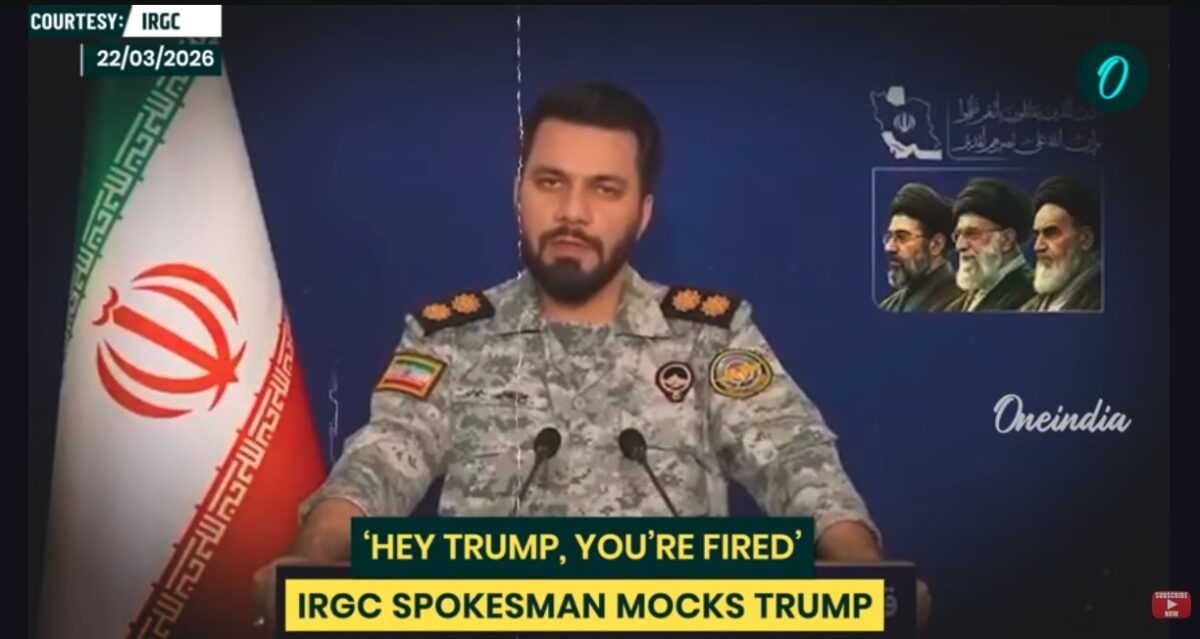
This morning, Pres. Trump seems finally to have realized that this war has not been going well for U.S.– or Israeli– interests. Just two days ago, on March 21, he’d issued a peremptory 48-hour deadline for Iran to immediately and fully open the Strait of Hormuz or face the major devastation of its power plants. Tehran then responded with a quite credible threat to retaliate in kind against the infrastructure of U.S. allies in the region,and of Israel. (And with mocking public pronouncements like this one.) Today, Trump backed down, extending his previous “deadline” for a further five days and claiming– without any evidence– that the IRI is engaged in negotiations with him that, he averred, seemed constructive.
Trump’s climbdown has (for now) calmed international financial and commodities markets previously set a-jitter by his issuance of the March 21 deadline. But the basic standoff between the IRI and Washington on the key issue of control over the Strait of Hormuz (and by extension, over the whole strategic area of the Gulf, more broadly) remains in place. The other, parallel contest being fought between Iran and Israel for control of the whole broader landmass of West Asia is a subsidiary of the bigger IRI-Washington standoff. (The ability of Tel Aviv to determine the outcome of the bigger IRI-Washington standoff is now shown to be quite constrained. It has, indeed, been shrinking every day since Israel and the U.S. launched their aggression of February 28.)
The IRI-U.S. standoff over control of the Gulf has– as noted above– significant impact on the state of the global economy and the broader geo-strategic balance of power. Ending this standoff in a way that is durable, cooperative, and can help return stability to the global order has to be an urgent priority for all the world’s governments and peoples. The United Nations (sadly) has very little role to play in the diplomacy that’s needed– not least because of the disgraceful fact of the Security Council’s adoption, on March 11, of a resolution that condemned Iran’s “egregious attacks” against its regional neighbors while making zero mention of the (far more egregious, and quite unprovoked) U.S.-Israeli attack against Iran of February 28.
The decisions of both China and Russia to abstain from voting on that resolution, rather than use their respective vetoes to block it, raises the intriguing question over why those two powers– especially China– chose not to fight this political-diplomatic battle within the United Nations. Both of them seemed thereby to be turning their backs on the institution that had hitherto, since 1945, played a cardinal role in ensuring and bolstering international peace and security. But it’s worth underlining that both those powers– especially China– have meanwhile invested considerable amounts of diplomatic time and thought in fora other than the UN Security, into exploring potential, peace-enhancing off-ramps from this war.
It is also undoubtedly the case that ever since the UN Security Council adopted, on November 17 of last year, the outrageous resolution by which it underwrote and endorsed Pres. Trump’s deeply flawed “Board of Peace” project for Gaza, the Security Council and the UN more broadly have lost a considerable amount of the legitimacy they’d previously enjoyed in their leadership of international affairs.
The brutal destruction that Portuguese commander Afonso de Albuquerque undertook in 1507 CE of the previously wealthy city of Hormuz, and of several other wealthy cities on both shores of the famous surrounding Strait, inaugurated a new era for the whole multi-layered Indian Ocean trading system of which it formed a key part.
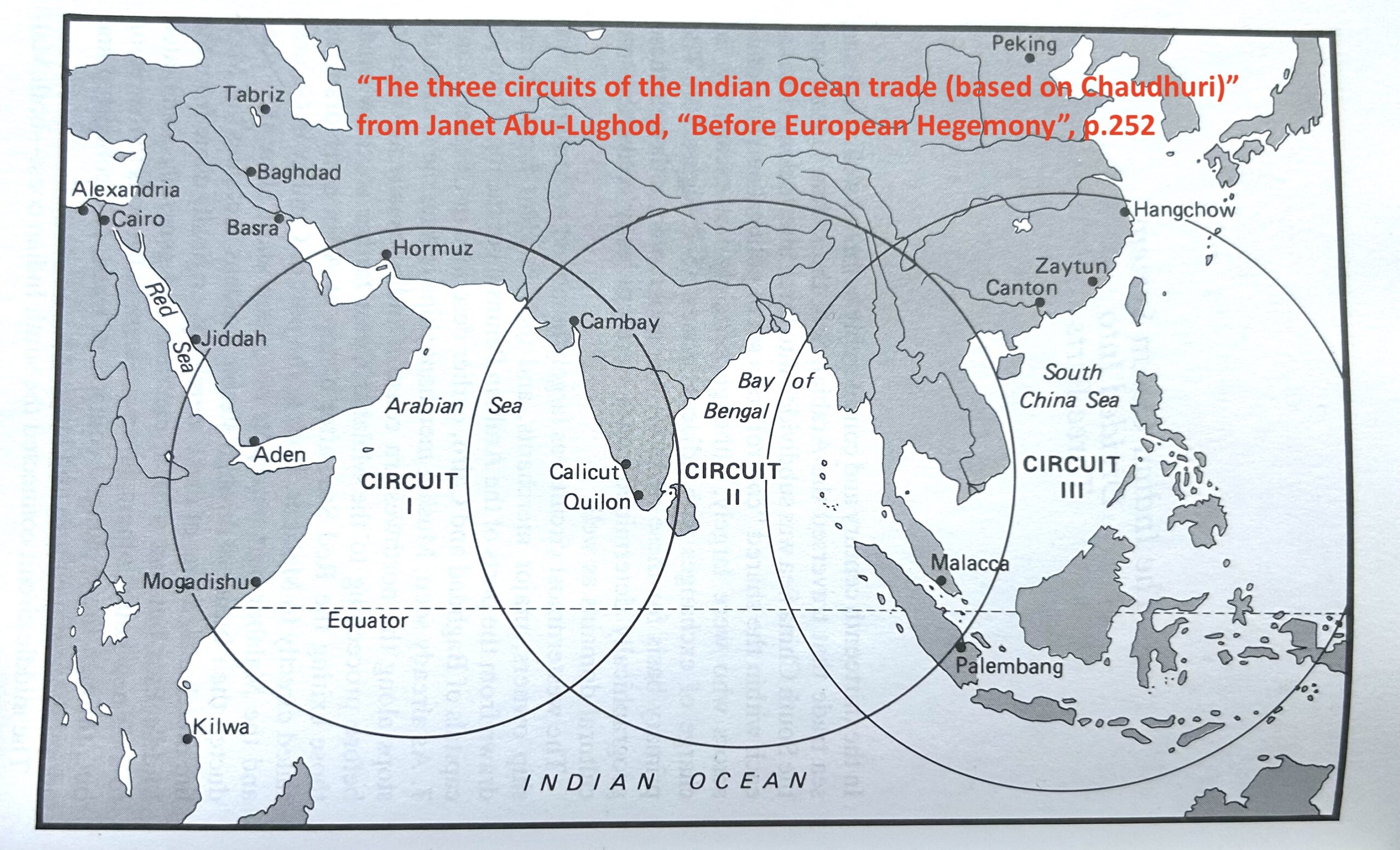
For centuries prior to that event, as Janet Abu-Lughod described expertly in her 1989 book Before European Hegemony: The World System A.D. 1250 – 1350, nearly the whole of the Indian Ocean had been a zone in which merchants from all the different shores could generally trade their wares freely with each other, subject only to the fees that the various different coastal polities imposed for port services, brokerage, and warehousing services. In most of the area of the three overlapping maritime “circuits” that Abu-Lughod identified, no single naval power “controlled” the seas distant from their own home shores. Merchants, travelers, and (mainly Muslim) pilgrims could travel long distances across these waters, generally pretty safely.
In the centuries prior to the entry into this system– via the route round Africa’s southern tip– of Portuguese marauders led by Vasco da Gama and then Afonso de Albuquerque, many of the cities and states that bordered the Indian ocean were wealthy and deployed technologies far beyond the dreams of the (relatively very backward) Europeans. When Da Gama, in 1498, was first able to gain an audience with the ruler (“samudri“) of the key Indian coastal city of Calicut he presented his host with the finest and most impressive gifts he could muster from his home-base, Portugal–and the samudri and his people reacted only with derision.
Indeed, the most important goal that motivated all the early West-European conquistadores who took the arduous voyage into the ocean via the Cape of Good Hope was access to the many fine riches that the ocean’s distant coastal communities could offer: not only many much-coveted spices but also gorgeous manufactured goods like porcelain and fine fabrics, and much more. (Another, linked goal was gaining access to these lovely and much-desired goods in a way that circumvented the Muslim traders of West Asia and the Mediterranean. Until 1498 those Muslim traders had had a monopoly on the “Oriental” trade. Da Gama, Albuquerque, and the Portuguese Catholic monarchs were eager to use their powerful naval gunnery in a way that could not only circumvent but also encircle the Muslim heartland. A continuation, in their view, of several centuries of both the anti-Muslim Crusades and the anti-Muslim Reconquista of Iberia.)
Thus, the Indian Ocean’s broad and supple trading zone became invaded by, first the Portuguese, then hard on their heels the Dutch, the English, and even the Spanish– who from 1521 on established a presence in the furthest East islands that became the Philippines, arriving from yet further east, in Central America.
All these conquerors from far distant lands on the extreme-west coast of Europe burst into the Indian Ocean trading zone with philosophies, goals, and political/military practices every different from those of the peoples of the ocean’s own littoral. These Europeans came in to plunder, to dominate, to carve out discrete zones of influence, and to control. They all stayed well into the 20th century of the Common Era; but by the latter decades only the settler-colonial offshoots of the Anglosphere still remained: the United States, and to a far smaller degree, Australia.
Now that we have all seen the extreme cruelty and devastation that United States (and its own settler-colonial offshoot, Israel) have brought to Iran, to Iran, and also now by extension to the other states of the Gulf region, it is time for all the U.S. military bases in that region to leave. Yes, just leave. Turn over the keys to all those military bases in the Gulf (and in Jordan, and Egypt) to the host governments, and allow those host governments to negotiate peaceably with Iran and other neighbors on how to build an enduing security and economic order for their region in which the citizens of all the littoral states can join, and can benefit.
So that’s what I think this war can and should be about: pursuing a vision in which the whole of the Gulf/Khalij can become a Zone of Peace that is free from the presence and interference of all external military forces, and in which the peoples of the littoral states– and Yemen, Iraq, and Jordan– can enjoy all their rights and jointly build robust institutions of cooperation that serve all them.
I would hope, too, that this vision of a collaborative, rapidly demilitarizing Zone of Peace is one that can soon be extended to the whole of West Asia, the whole of the Indian Ocean, and other parts of the world as well. Once the power of the United States to violently coerce and bully the proud people of one of the states of this region has been radically curtailed, so too will the ability of Washington’s offshoot, Israel, to do the same to the people Gaza, the rest of Palestine, and of Lebanon.
But let the implementation of this vision of a Zone of Peace start in the Gulf. This is a world-defining region that has witnessed far too much devastation over the past 35 years, and especially the past 24 days.
