

There is still quite some confusion about the diplomatic role that Pakistan is playing in the ongoing U.S.-Israeli War on Iran.
As is quite clear by now, Trump’s pronouncements regarding the war are bombastic and often contradictory. But every few days he and his handlers try to pursue what they clearly think of as a “smart” psy-ops move, namely to say that they’re “in productive discussions” with Tehran, or something similar. They imply these “negotiations”, conducted through Pakistan, might even be near complete success.
But time after time after time, the Iranians reiterate: “No we are not in negotiations with Washington. At this point we have zero interest in such negotiations.”
Yet the DC psy-ops utterances continue. And that has led some people to conclude that “the Pakistan channel” has been a complete failure, and Pakistan has no role to play in seeking an offramp.
People who think that— spurred perhaps by this recent analysis of “the Pakistan channel”, or other similar analyses— are, I submit, looking at the role Pakistan is playing in the diplomacy around ending the current war in a very misguided way. The most important role Islamabad is playing is not as a “mediator” between Tehran and Washington DC, or even as a more passive, note-passing “post-box” between the two. Rather, it is as a key partner for China in the long, patient diplomatic project of— as I described it here last Friday— “reeling in the GCC states”, into the project to end the war on a fair and sustainable basis.
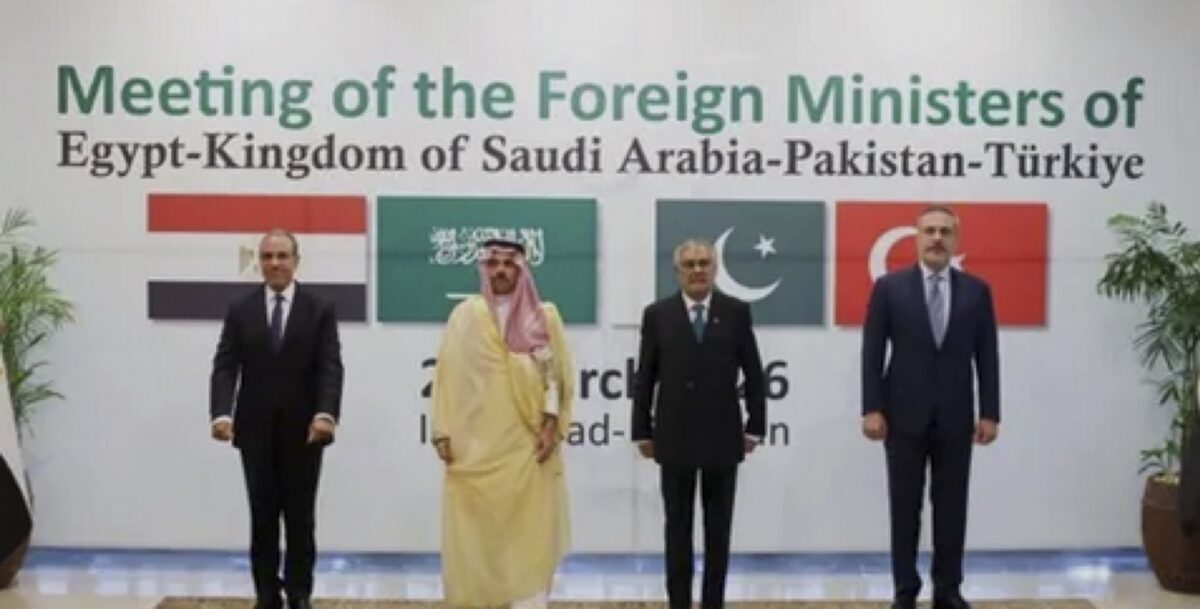
Indeed, it is not just the GCC states that China and Pakistan have been reeling in. This meeting, in Islamabad on March 29, was a key building-block in the ongoing diplomatic project:
As I noted in my post last Friday, Saudi Arabia is far and away the weightiest of the GCC states. It and all the other five GCC states have until now been tightly tied in to U.S. war planning for not only the Gulf/Khalij but also the rest of West Asia. For the smart diplomats of the Pakistan-China alliance to be able to reel in not just Saudi Arabia but also (long-time U.S. partners) Egypt and Turkey into their project shows it is having some “real” effects. There are numerous other indicators, too.
In the search for a sustainable, fair exit from this war, the progress of this patient Chinese-Pakistani initiative is truly the right space to watch: …
